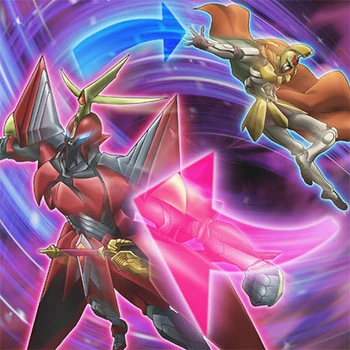
Heroic Deck #761591 — Yu-Gi-Oh! Master Duel
60 Main, 15 Extra, incl. Destiny HERO - Malicious x3, Elemental HERO Stratos x3, Miracle Ejector x3.
Created by: YGO Mod (20517634)
Created On: 10/05/2026
Main Deck (60)
- Destiny HERO - Denier x1
- Destiny HERO - Malicious x3
- Destiny HERO - Plasma x1
- Droll & Lock Bird x2
- Elemental HERO Blazeman x1
- Elemental HERO Shadow Mist x1
- Elemental HERO Stratos x3
- Masked HERO Dusk Crow x1
- Masked HERO Fountain x1
- Masked HERO Furnace x1
- Maxx "C" x1
- Miracle Ejector x3
- Mulcharmy Fuwalos x3
- Mulcharmy Purulia x2
- Neo-Spacian Aqua Dolphin x1
- Vision HERO Faris x3
- Vision HERO Increase x1
- Vision HERO Vyon x2
- Winged Kuriboh Sabatiel LV10 x3
- Elemental HERO Neos x1
- Ash Blossom & Joyous Spring x3
- A Hero Lives x3
- Crossout Designator x1
- E - Emergency Call x2
- EN Shuffle x1
- Foolish Burial x1
- Forbidden Crown x2
- Forbidden Droplet x3
- Fusion Destiny x3
- Mask Change x1
- Miracle Fusion x1
- Polymerization x2
- Super Polymerization x1
- Favorite Contact x1
Extra Deck (15)
- Contrast HERO Chaos x2
- Destiny HERO - Destroyer Phoenix Enforcer x1
- Elemental HERO Flame Wingman - Infernal Rage x1
- Elemental HERO Shining Neos Wingman x1
- Elemental HERO Sunrise x1
- Elemental HERO Thunder Giant - Voltic Thunder x1
- Favorite HERO Flame Wingman x1
- Favorite HERO Shining Flare Wingman x1
- Masked HERO Dark Law x1
- Vision HERO Trinity x1
- Predaplant Verte Anaconda x1
- Xtra HERO Cross Crusader x1
- Xtra HERO Infernal Devicer x1
- Xtra HERO Wonder Driver x1
Couldn't load the deck
Deck — Deck Power Evaluation
Final Contextual Deck Power: 62/100 (±6 · Confidence: Medium)
| Overall score | Value |
|---|---|
| Structural Deck Power | 67 |
| Going First | 66 |
| Going Second | 64 |
| Meta Power | provisional |
| Tournament Reliability | 61 |
- Primary strategy: Combo
- Secondary strategies: Midrange
- Format: master-duel
Legality
Main 60 / Extra 15 / Side 0 — status: Legal.
Identity & game plan
- Win condition: Fusion Summon a HERO Fusion boss (Neos line, Sunrise, Chaos, Shining Neos Wingman) from Extra Deck, enabled by Polymerization-family spells and Miracle Fusion from the field and GY.; Link and Fusion follow-ups (Xtra HERO Infernal Devicer, Xtra HERO Cross Crusader, Favorite HERO Shining Flare Wingman) that keep the board going after the first boss.
- Turn 1 (going first): Turn 1 starter (A Hero Lives, Stratos, Faris, Vyon, Fuwalos) into a search for an Elemental HERO or Polymerization card, then a Fusion Summon in the Main Phase.
- Turn 2 (going second): Hold Ash Blossom, Droll and Maxx C to answer the opponent's first search or summon, then rebuild a Fusion from the field and GY using the same starters.
- Recovery: Recur HERO monsters from the GY with Destiny HERO - Malicious and Vision HERO Increase, and reload Polymerization through Vision HERO Vyon and Masked HERO Fountain.
- After siding: Not evaluable: the deck has no side deck (Side Deck size 0), so there is no post-side plan to score.
Why it scores here
The deck opens a functional plan reliably: the 28 core HERO copies give a 96% chance of at least one in a 5-card opening hand (hypergeometric, Inferred), and 17 searchers give about 82%. Its conversion ceiling comes from the Extra Deck (11 Fusion, 4 Link across 14 distinct cards), but no recorded boards exist, so the ceiling and the median are both text-based inference and the median is held to a lower score. Resilience comes from six hand traps (three Ash Blossom, two Droll and Lock Bird, one Maxx C) plus Forbidden Droplet and Forbidden Crown, which together give a reasonable answer to a first interruption. The main weaknesses are the absence of a side deck, which drags adaptability and tournament reliability down, and a 60-card main with a spread of HERO sub-archetypes (Elemental, Destiny, Vision, Masked) and 75 off-archetype copies that lowers compactness. Popularity did not earn points: the archetype usage data only confirms that the list runs the standard core (16 of 25 core cards present), and the score was built from the deck's system, not by averaging the individual card scores.
Dimension scores
| # | Dimension | Score | Evidence |
|---|---|---|---|
| D1 | Engine Accessibility & Consistency | 78 | P(at least one of 28 core HERO copies in a 5-card opening hand) = 0.963 and 17 searchers give P = 0.824; redundant turn-1 starters (A Hero Lives x3, Stratos, Faris, Vyon) (Inferred) |
| D2 | Opening-Hand Quality & Brick Management | 68 | Full-brick proxy 0.037 for the core group; dead-card risk from conditional cards (Forbidden Droplet, Forbidden Crown, Mulcharmy 'if you control no cards') and six hand traps that need a specific timing (Inferred) |
| D3 | Combo Conversion & Ceiling | 70 | Ceiling reaches Masked HERO Dark Law, Neos-line Fusions and Sunrise from a short chain of Polymerization, Miracle Fusion and Mask Change; no recorded boards to confirm (Inferred semantic read from card text) |
| D4 | Combo Floor & Median Output | 56 | No recorded boards, so median output is not observed; estimated from the recurrence of searchers and Polymerization-family spells in a typical opening (Inferred) |
| D5 | Interruption Resilience & Route Redundancy | 74 | Three Ash Blossom, two Droll and Lock Bird, one Maxx C and multiple independent starters give several continuation routes after a single disruption (Inferred from card text and copy counts) |
| D6 | Resource Economy, Recovery & Grind | 66 | Recursion through Destiny HERO - Malicious, Vision HERO Increase and Fusion Destiny, plus Mulcharmy draw effects, support grind; the 60-card main is a cost to this score (Inferred) |
| D7 | End-Board & Interaction Quality | 74 | Three Ash Blossom, two Droll and Lock Bird, Maxx C, three Forbidden Droplet, two Forbidden Crown, Crossout Designator and Dark Law's banish give broad, layered interaction (Inferred semantic read; hand-trap flags confirmed) |
| D8 | Going-Second & Board-Breaking Power | 66 | Forbidden Droplet, Forbidden Crown and Super Polymerization can challenge a going-second board, and Fusions can be built from both fields; no going-second win-rate data exists (Inferred) |
| D9 | Offensive Pressure & Closing Power | 70 | Neos (2500 ATK), Sunrise (2500), Shining Neos Wingman (3100) and Chaos (3000) give a high closing ceiling; no end-board observations (Inferred from ATK stats) |
| D10 | Main Deck Efficiency & Flexibility | 58 | Legal 60/15/0 with 34 distinct main cards, 18 singles and 21 Spells; many off-archetype staples and conditional cards lower compactness (Inferred from composition) |
| D11 | Extra Deck Efficiency & Coverage | 66 | All 15 Extra slots are used by 14 distinct cards; the Fusions and Links are mostly HERO-specific but several need a particular material, so coverage is wide but not fully reliable (Inferred) |
| D12 | Side Deck Adaptability | 15 | No side deck (Side Deck size 0); no best-of-3 adaptation is possible, so this score reflects the missing post-side plan (Provisional) |
| D13 | Matchup Coverage & Format Fit | 50 | No tournament link or dated meta sample in the export; the archetype is a known Heroic list but its matchup fit cannot be measured (Provisional) |
| D14 | Pilotability & Error Tolerance | 55 | Multi-step chains (Polymerization into Fusion, Mask Change, Fusion Destiny timing, Miracle Fusion banishing) with several decision points for the pilot; moderate-to-high error risk (Inferred) |
How the score was computed
Strategy profile: Combo. Structural ≈ 67, Going First ≈ 66, Going Second ≈ 64, Meta = provisional, Tournament Reliability ≈ 61. Modifiers: Banlist exposure (-1); Engine spread across sub-archetypes (-2); Engine compactness (-1). Final formula: 0.80*Structural + 0.20*TournamentReliability + ContextModifiers (Meta provisional) = 0.80*67.28 + 0.20*61.35 - 4 = 62.02 -> 62
Probability & combo summary
- Opening a starter: P(≥1) ≈ 0.96 · key two-card combo ≈ — · full-brick estimate ≈ 0.04 (all Inferred)
- Combo output: best PowerIndex —, median —, board-per-starter —
- Turn order: 0 going-first lines vs 0 going-second lines
Strengths
- Dense starter and searcher density gives a high chance of a live opening (96% core-in-hand proxy, Inferred).
- Layered interaction: six hand traps plus Forbidden Droplet and Forbidden Crown.
- Large Extra Deck coverage with several high-ATK Fusion and Link closers.
- Redundant recursion lines (Malicious, Increase, Fusion Destiny) support continuation after disruption.
Weaknesses
- No side deck: best-of-3 adaptation is impossible (Side Deck size 0).
- Engine spread across sub-archetypes (0% exact-name purity), which weakens coherence.
- Several conditional or narrow cards (Forbidden Droplet, Forbidden Crown, Mulcharmy) that can brick or be dead in some hands.
- No recorded combos, so the ceiling and median are text-based and unverified.
Critical choke points
- Polymerization-family spells (Polymerization x2, Miracle Fusion, Super Polymerization x1) are the only route to the Fusion boss in most lines; losing them to a single hand trap or a Droll-style lock removes the main plan.
- Ash Blossom and Droll and Lock Bird are the only answers to a first search or summon, so their count sets how often the deck survives a turn-1 interruption.
- Dark Law and Neos-line bosses require specific material; a missing material card ends the Fusion line.
Recommended changes
| Priority | Remove | Add | Reason |
|---|---|---|---|
| 1 | Add a 15-card side deck (hand traps and anti-negation or anti-floodgate cards), because the deck currently has no post-side plan and D12 is 15. | Side deck construction is the biggest single gap; it lifts D12 and Tournament Reliability. | |
| 2 | One Forbidden Crown | A second Miracle Fusion or a single-copy searcher that fits the core engine | Forbidden Crown needs a face-up target and is a dead card in some hands; a core-engine card keeps more hands live. |
| 3 | One Mulcharmy Purulia | A second copy of a core HERO starter or searcher | Mulcharmy's conditional effects reduce hand consistency; a core starter gives more reliable turn-1 access. |
Evidence & confidence
- Verified: Legal 60/15/0 in master-duel; all copy limits met (Limited cards at 1 copy, Semi-Limited at or under limit).; Card text and banlist status for each card as supplied in the evidence.; Archetype core group of 28 copies from the usage stat (core_present 16 of 25).
- Inferred: Probability estimates: 0.963 core-in-hand, 0.824 searcher-in-hand, 0.037 proxy brick.; Conversion ceiling and continuation routes from card text.; Interaction density from hand-trap and negation text.; Going-first and going-second estimates.
- Provisional: Meta Power (null) and matchup fit (D13) need a dated metagame sample.; Tournament Reliability is partly provisional because there is no win-rate data.
- Data gaps: No combos supplied: combo floor, median and ceiling are text-only inference. No tournament link: archetype meta-share and per-pilot match record are absent. No win-rate telemetry (going-first, going-second, matchup, brick or OTK rates). Meta Power is provisional unless a dated metagame sample is supplied. The deck has no side deck, so post-side performance cannot be assessed.
Couldn't load the combos