Traptrix Deck #773647 — Yu-Gi-Oh! Duel Links
30 Main, 9 Extra, incl. Mulcharmy Fuwalos x3, Traptrix Dionaea x3, Traptrix Myrmeleo x3 - Skill: Traptrix Territory. Created Oct 24, 2026 by YGO Mod.
Created by: YGO Mod (20517634)
Created On: 10/24/2026


 Traptrix Territory
Main Deck (30)
- Droll & Lock Bird x2
- Kumongous, the Sticky String Kaiju x2
- Mulcharmy Fuwalos x3
- Nibiru, the Primal Being x1
- Traptrix Atrax x1
- Traptrix Dionaea x3
- Traptrix Mantis x1
- Traptrix Myrmeleo x3
- Traptrix Pudica x3
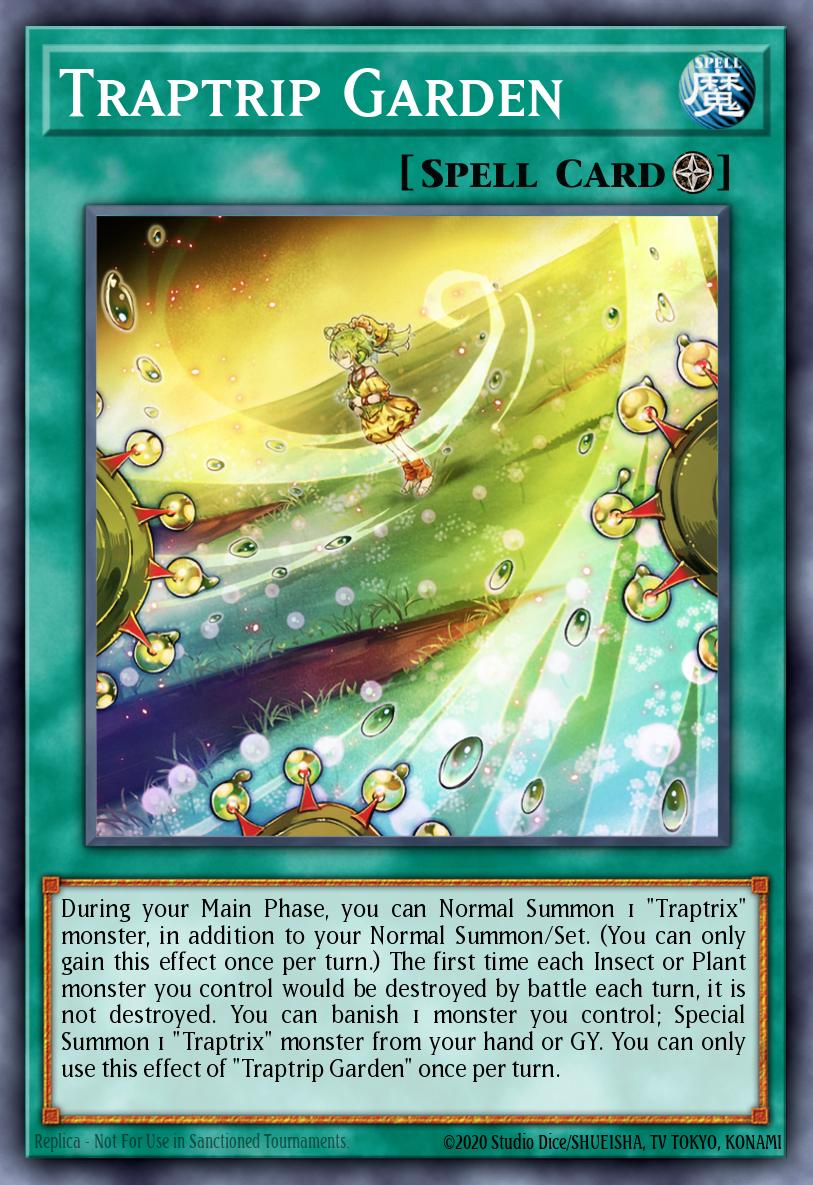
- Traptrip Garden x3
- Break Off Trap Hole x1
- Floodgate Trap Hole x1
- Terrifying Trap Hole Nightmare x1
- Time-Space Trap Hole x1
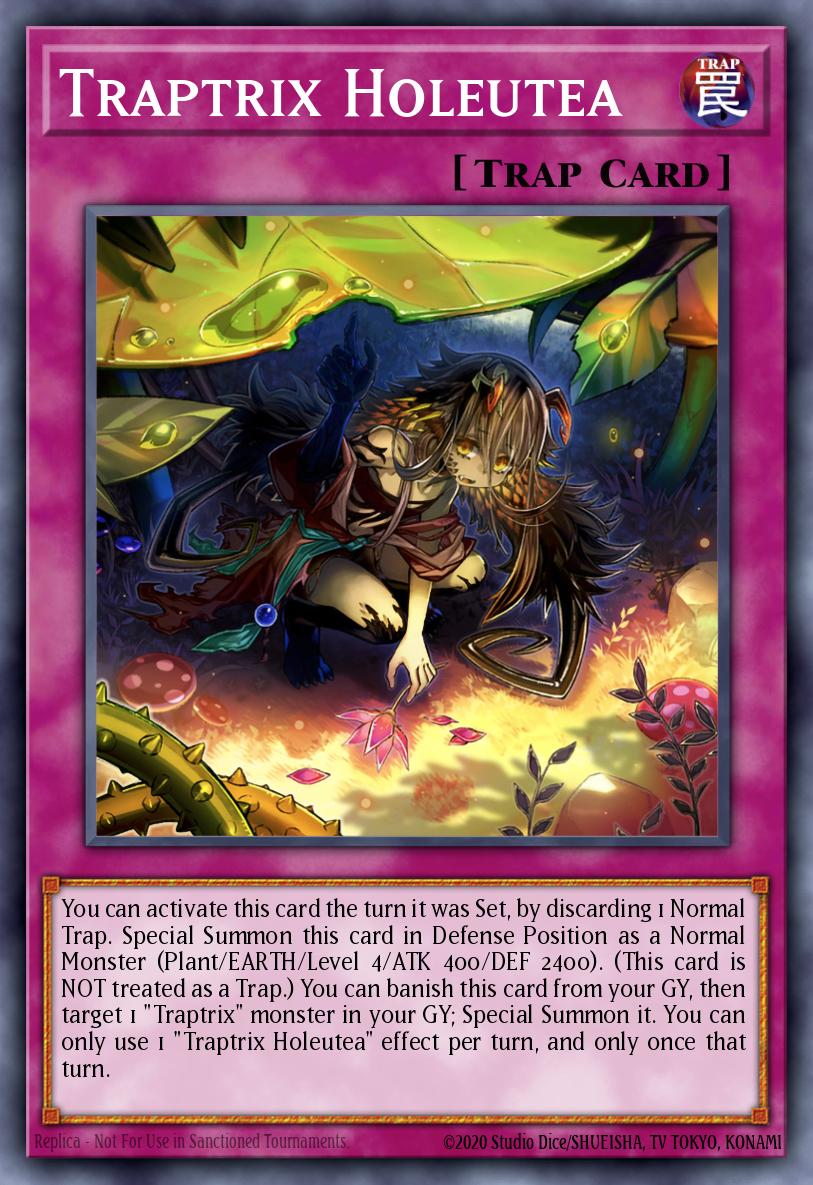
- Traptrix Holeutea x3
- Traptrix Trap Hole Nightmare x1
Extra Deck (9)
Couldn't load the deck
Deck — Deck Power Evaluation
Final Contextual Deck Power: 65/100 (±5 · Confidence: Medium)
| Overall score | Value |
|---|---|
| Structural Deck Power | 67 |
| Going First | 72 |
| Going Second | 58 |
| Meta Power | provisional |
| Tournament Reliability | 64 |
- Primary strategy: Control
- Secondary strategies: Midrange
- Format: duel-links
Legality
Main 30 / Extra 9 / Side 0 — status: Legal.
Identity & game plan
- Win condition: Out-grind with Traptrix Link/Xyz loops and Hole traps, then close with Pinguicula, Atypus, TY-PHON, or Underworld Goddess.; Going-second Kaiju/Nibiru plus Extra Deck removal into a simplified game.
- Turn 1 (going first): Normal Summon a Traptrix searcher, search Traptrip Garden or a Hole trap, set 1-2 traps, and build Sera/Rafflesia/Pinguicula when available.
- Turn 2 (going second): Use Fuwalos, Droll, Kaiju, or Nibiru to slow or break the opponent's board, then resolve a Traptrix engine and remove remaining threats with S:P, Underworld Goddess, or Atypus.
- Recovery: Recover through Dionaea and Holeutea Graveyard effects, then use Cularia and Sera to re-set Hole traps and Pinguicula to search follow-up.
- After siding: No Side Deck is registered; in a best-of-3 context this list has no demonstrated post-side configuration.
Why it scores here
Traptrix is a legal 30-card Duel Links trap-control list whose main engine is dense: 11 Traptrix monsters give roughly 92% to open at least one in a five-card hand, with seven searcher-text copies and Traptrip Garden backing up the Normal Summon. Its realistic median is a Traptrix body plus one searched or set Hole trap, with Sera/Rafflesia adding protection and recursion; the deck is not a high-ceiling combo build, and no recorded boards exist, so floor/median/ceiling are text-inferred. It gains most of its structural value from the grind loop (Sera, Cularia, Holeutea, Pinguicula) and the breadth of reactive traps, but loses points going second, on dead reactive cards, on Extra Deck choke points, and because no Side Deck or post-side plan is registered. The score is a system score, not an average of card power; usage share and Traptrix popularity did not earn points, and matchup/meta power remains provisional without a dated metagame sample.
Dimension scores
| # | Dimension | Score | Evidence |
|---|---|---|---|
| D1 | Engine Accessibility & Consistency | 76 | 11 Traptrix monsters (≈0.92 to open at least one in five) plus 7 searcher-text copies make the core live most hands; Holeutea adds conditional access (Inferred). |
| D2 | Opening-Hand Quality & Brick Management | 70 | The 30-card list has many 3-of engine cards, but 8 reactive non-engine cards (Fuwalos/Droll/Nibiru/Kaiju) can be poor going first; full-brick estimate is roughly 7-10% (Inferred). |
| D3 | Combo Conversion & Ceiling | 56 | No recorded boards exist; text supports a realistic ceiling of Sera/Cularia plus a Rank 4 and 1-2 Hole traps, not a multi-negate combo board (Inferred). |
| D4 | Combo Floor & Median Output | 66 | Median expectation is one Traptrix Normal Summon backed by a searched/set Hole trap; Sera or Rafflesia appears only when the pieces line up (Inferred). |
| D5 | Interruption Resilience & Route Redundancy | 68 | Dionaea, Holeutea and Sera/Cularia give recovery after trades, but the deck has limited starter-independent lines if the Normal Summon is answered (Inferred). |
| D6 | Resource Economy, Recovery & Grind | 80 | Cularia re-Sets Hole traps, Holeutea revives, Pinguicula searches and Rafflesia protects; this recursive grind loop is the clearest strength (Inferred). |
| D7 | End-Board & Interaction Quality | 74 | 8 main-deck traps include Floodgate, Time-Space, Break Off and Traptrix Nightmare, while Rafflesia converts Hole traps from Deck; interaction is broad but reactive (Inferred). |
| D8 | Going-Second & Board-Breaking Power | 56 | Kaiju x2, Nibiru x1 and Extra Deck removal (S:P, Underworld Goddess, TY-PHON) help, but the trap-first core cannot consistently break a board on turn two (Inferred). |
| D9 | Offensive Pressure & Closing Power | 46 | ATK tops at 2500-3000 from Pinguicula/Atypus/TY-PHON/Underworld Goddess; closing power is adequate but not an OTK plan (Inferred). |
| D10 | Main Deck Efficiency & Flexibility | 72 | The 30-card Duel Links limit with 16 distinct main cards and a heavy 3-of core is compact; several 1-of traps and 8 non-engine cards are the main inefficiencies (Inferred). |
| D11 | Extra Deck Efficiency & Coverage | 74 | All 9 Extra slots cover Sera, Cularia, Atypus, Pinguicula, Rafflesia, S:P, I:P, TY-PHON and Underworld Goddess; coverage is good but there are no duplicate utility slots (Inferred). |
| D12 | Side Deck Adaptability | 40 | No Side Deck is registered; in a best-of-3 context this deck has no demonstrated post-side configuration (Inferred). |
| D13 | Matchup Coverage & Format Fit | 50 | No dated metagame sample or tournament link is present; format fit is provisional (Provisional). |
| D14 | Pilotability & Error Tolerance | 68 | Lines are mostly Normal Summon/search/set traps with sequencing decisions around Sera and Hole traps; error tolerance is moderate (Inferred). |
How the score was computed
Strategy profile: Control. Structural ≈ 67, Going First ≈ 72, Going Second ≈ 58, Meta = provisional, Tournament Reliability ≈ 64. Modifiers: Engine compactness (2); Hard-garnet burden (-2); Extra Deck choke point (-1). Final formula: 0.80*Structural + 0.20*TournamentReliability (Meta provisional)
Probability & combo summary
- Opening a starter: P(≥1) ≈ 0.92 · key two-card combo ≈ 0.38 · full-brick estimate ≈ 0.07 (all Inferred)
- Combo output: best PowerIndex —, median —, board-per-starter —
- Turn order: 0 going-first lines vs 0 going-second lines
Strengths
- High density of 3-of Traptrix starters and searchers keeps the engine live in most opening hands.
- Strong grind loop through Sera, Cularia, Holeutea and Pinguicula.
- Broad reactive trap suite including Floodgate, Time-Space, Break Off and Traptrix Nightmare, with Rafflesia as a Hole-trap toolbox.
- Extra Deck includes generic removal and closeout options such as S:P, Underworld Goddess and TY-PHON.
- Legal, compact Duel Links list with no restricted-card exposure.
Weaknesses
- The trap-first shell is much weaker going second and lacks a reliable turn-two board breaker beyond Kaiju/Nibiru and Extra Deck removal.
- Several reactive cards (Droll, Nibiru, Kaiju, Fuwalos) can be poor going first, increasing dead-hand risk.
- No Side Deck and no post-side plan are present in the evidence.
- Dependence on the Normal Summon and on Extra Deck names like Sera and Rafflesia creates choke points.
- No combo evidence, no Duel Links skill data, and no dated metagame sample; power is inferred rather than measured.
Critical choke points
- Normal Summon is answered before a Traptrix search resolves.
- Sera or Rafflesia is removed before the grind loop starts.
- Backrow removal clears set Hole traps before the opponent commits.
- No Side Deck means no demonstrated best-of-3 adaptation.
- Duel Links skill is not supplied, so an important power component is unknown.
Recommended changes
| Priority | Remove | Add | Reason |
|---|---|---|---|
| 1 | 1 I:P Masquerena | 1 Traptrix Sera | Sera is the deck's main Normal Trap payoff; a second copy raises grind consistency, while I:P is more situational in this trap-first build. |
| 2 | 1 Kumongous, the Sticky String Kaiju | 1 Traptrix Arachnocampa (usage-stat core piece if legal in the format) | Usage statistics list Arachnocampa in 60% of Traptrix lists; an extra searchable Traptrix body improves going-first consistency while one Kaiju remains for going second. |
| 3 | 1 Droll & Lock Bird | 1 Chain Hole (usage-stat tech if legal in the format) | Droll is matchup-dependent; more in-archetype trap density supports Sera and Rafflesia lines. |
Evidence & confidence
- Verified: Deck is legal in Duel Links: 30 Main, 9 Extra, 0 Side, no violations.; Card text and banlist statuses for all resolved cards are present.; Composition is 19 Effect Monsters, 8 Traps and 3 Spells in Main; Extra is 6 Link and 3 Xyz.; Usage statistics contain 24 rows and show Holeutea, Pudica, Traptrip Garden and other Traptrix cards as high-inclusion cards.
- Observed: No parseable combo boards were supplied (combo data total 0).; Only one guide mention is attached, with no strategic sections.
- Inferred: Opening-starter probability and brick estimates are hypergeometric inferences.; The trap-control plan, grind loop, going-second weakness and choke points are inferred from card text.; Extra Deck utility and interaction quality are inferred from card text, not measured boards.
- Provisional: Meta Power and matchup/format fit are provisional because no dated metagame sample or tournament link exists.; Post-side performance is provisional because no Side Deck is registered.
- Data gaps: No combos supplied — combo floor/median/ceiling is text-only inference. No tournament link — archetype meta-share and per-pilot match record absent. No win-rate telemetry exists in YGOVN (going-first/second, matchup, game-level, brick/starter/OTK rates) — those signals are Inferred or Unknown. Meta Power is Provisional unless a dated metagame sample is supplied. No Duel Links skill supplied; skill effects are not evaluated. Usage_statistics 'in this deck' flags conflict with the resolved Extra Deck list for several cards; the actual resolved card list was used.
Couldn't load the combos