





Mathmech Deck #754202 — Yu-Gi-Oh! Duel Links
20 Main, 9 Extra, incl. Mathmech Diameter x3, Mathmech Sigma x3, Book of Eclipse x3 - Skill: Mathmech Slicer. Created Sep 22, 2026 by YGO Mod.
Created by: YGO Mod (20517634)
Created On: 09/22/2026

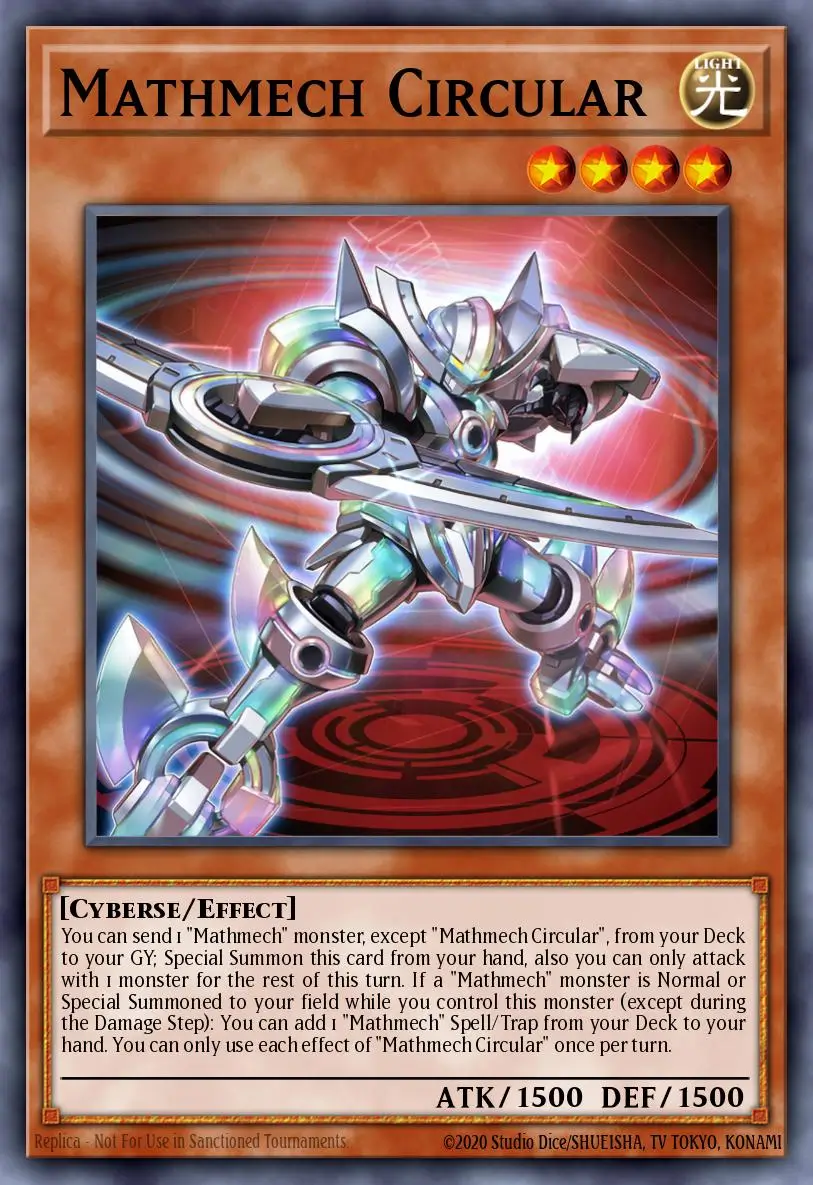
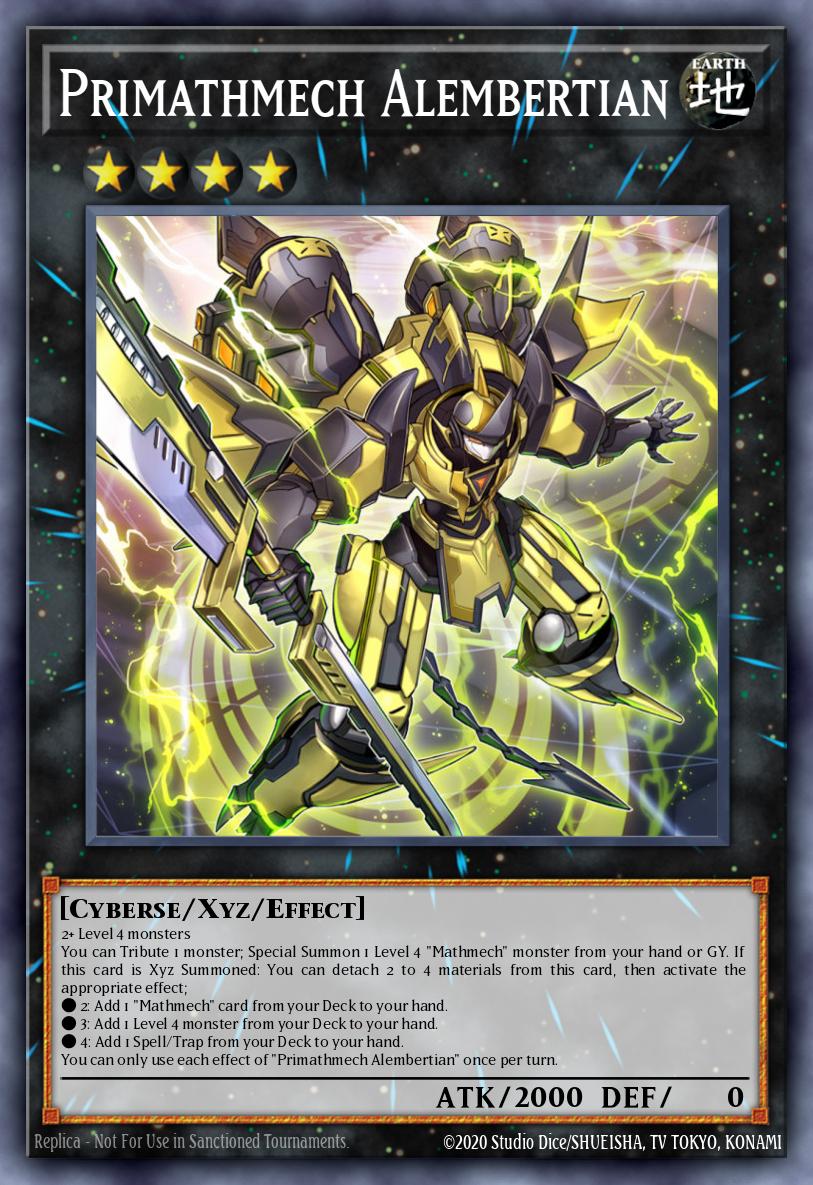
 Mathmech Slicer
Main Deck (20)
- Artifact Lancea x2
- Mathmech Addition x1
- Mathmech Multiplication x1
- Mathmech Diameter x3
- Mathmech Nabla x1
- Mathmech Sigma x3
- Book of Eclipse x3
- Forbidden Droplet x3
- Mathmech Equation x1
- Mathmech Induction x1
- Mathmech Superfactorial x1
Extra Deck (9)
Couldn't load the deck
Deck — Deck Power Evaluation
Final Contextual Deck Power: 59/100 (±6 · Confidence: Medium)
| Overall score | Value |
|---|---|
| Structural Deck Power | 61 |
| Going First | 63 |
| Going Second | 57 |
| Meta Power | provisional |
| Tournament Reliability | 60 |
- Primary strategy: Midrange
- Secondary strategies: Tempo, Toolbox
- Format: duel-links
Legality
Main 20 / Extra 9 / Side 0 — status: Legal.
Identity & game plan
- Win condition: Extra Deck boss monsters (Geomathmech Final Sigma x2, Primathmech Laplacian x2) built from a Mathmech board, with Synchro/Link/Xyz follow-ups for pressure; Link and Synchro pressure from Link-3 and Synchro monsters (S-Force Justify, Topologic Trisbaena, Decode Talker Heatsoul, Geomathmech Magma) once the board is established
- Turn 1 (going first): Normal Summon Mathmech Diameter or Sigma (3 copies each) to reach a Level 4 Cyberse body, use Mathmech Addition or Equation to Special Summon from GY, then build a Synchro or Xyz into the Extra Deck bosses
- Turn 2 (going second): Use Artifact Lancea (x2) as a hand trap or Forbidden Droplet to answer the opponent's first board, then rebuild through Mathmech GY recursion into a Final Sigma or Laplacian
- Recovery: Mathmech monsters in the GY can be Special Summoned again through Equation, Addition and Multiplication, and Superfactorial can Synchro Summon from GY materials, so the engine recurs without a searcher
- After siding: No side deck in Duel Links (side_count 0); the post-interaction plan is to re-route through Trisbaena banish and Final Sigma negation, not sideboarding
Why it scores here
The deck reliably opens a Mathmech engine: the 14 archetype-core copies give an estimated P(at least one Mathmech starter in a going-first 5-card hand) of about 0.87 and about 0.92 going second, computed from the main deck (Inferred). Conversion into the Extra Deck is real, because Final Sigma and Laplacian (2 copies each) plus Link-3 pressure give several boss routes, and the GY recursion lets the engine continue after a single removal or negation. Interaction is reasonable: 7 negation-text cards, 6 removal-text cards, two Artifact Lancea hand traps and Superfactorial, though Superfactorial is Limited and runs one copy. The score does not come from Mathmech being a popular archetype: the guide only places it at Tier 3, and usage stats confirm the list is standard rather than strong. No recorded boards exist, so median and ceiling are text-based inference, and card scores were not averaged.
Dimension scores
| # | Dimension | Score | Evidence |
|---|---|---|---|
| D1 | Engine Accessibility & Consistency | 72 | P(>=1 Mathmech starter in 5) ~0.87 combining Diameter/Sigma/Equation/Addition; 14 archetype-core copies (Inferred) |
| D2 | Opening-Hand Quality & Brick Management | 60 | Two Tuner-heavy 3-copy cards plus several single-copy flex slots and two non-engine spells raise brick risk moderately (Inferred) |
| D3 | Combo Conversion & Ceiling | 68 | Final Sigma and Laplacian give a strong boss ceiling, but no recorded boards to confirm it (Inferred) |
| D4 | Combo Floor & Median Output | 55 | No parseable boards; median estimated from text and starter diversity only (Inferred) |
| D5 | Interruption Resilience & Route Redundancy | 62 | Mathmech GY recursion and two hand traps give alternate routes after disruption (Inferred) |
| D6 | Resource Economy, Recovery & Grind | 55 | No searcher text in the list; Final Sigma and Magma recover one Mathmech Spell/Trap, so grind is modest (Inferred) |
| D7 | End-Board & Interaction Quality | 68 | Seven negation-text and six removal-text cards plus Superfactorial and Induction give layered interaction (Inferred semantic) |
| D8 | Going-Second & Board-Breaking Power | 60 | Two Artifact Lancea hand traps and Forbidden Droplet cover the going-second board, but there is no removal depth beyond this (Inferred) |
| D9 | Offensive Pressure & Closing Power | 66 | Final Sigma's doubled battle damage and Link-3 boss ATKs (2300-3000) give strong closing power (Inferred from card text) |
| D10 | Main Deck Efficiency & Flexibility | 62 | 20 main with 6 singleton slots and a 3-copy core; the singles are partly flex, so compactness is average (Verified composition) |
| D11 | Extra Deck Efficiency & Coverage | 64 | All 9 Extra slots are used by engine bosses and links, with Final Sigma and Laplacian as the mandatory core (Verified composition) |
| D12 | Side Deck Adaptability | 40 | Duel Links has no side deck and side_count is 0, so adaptability is Provisional (Provisional) |
| D13 | Matchup Coverage & Format Fit | 50 | Tournament share and per-pilot records are absent; only a Tier 3 guide mention (Provisional) |
| D14 | Pilotability & Error Tolerance | 55 | Multi-step Synchro/Xyz/Link sequencing with Extra-Deck choices raises the decision load (Inferred) |
How the score was computed
Strategy profile: Midrange. Structural ≈ 61, Going First ≈ 63, Going Second ≈ 57, Meta = provisional, Tournament Reliability ≈ 60. Modifiers: banlist_exposure (-2). Final formula: 0.80*Structural + 0.20*TournamentReliability (Meta provisional) + ContextModifiers = 0.80*61 + 0.20*60 - 2 = 58.8, rounded to 59
Probability & combo summary
- Opening a starter: P(≥1) ≈ 0.87 · key two-card combo ≈ — · full-brick estimate ≈ — (all Inferred)
- Combo output: best PowerIndex —, median —, board-per-starter —
- Turn order: 0 going-first lines vs 0 going-second lines
Strengths
- Engine density: 14 archetype-core copies give a high chance of a Mathmech starter in the opening hand
- Extra Deck bosses (Final Sigma, Laplacian) give ceiling and closing power
- Recursion through Mathmech GY cards gives resilience after disruption
- Multiple negation and removal text cards cover the endboard
Weaknesses
- No recorded boards, so the median and ceiling are unverified
- Superfactorial is Limited and runs one copy, a single point of failure for one engine route
- Two non-engine spells (Book of Eclipse, Forbidden Droplet) add brick risk
- No searcher text in the list, so the deck relies on draws and GY recursion
Critical choke points
- The Level 4 Cyberse starter (Diameter or Sigma) being removed or negated before the engine is live
- Final Sigma and Laplacian on the Extra Deck, with 2 copies each being the only boss routes
Recommended changes
| Priority | Remove | Add | Reason |
|---|---|---|---|
| 1 | Book of Eclipse | Mathmech Subtraction or a second Mathmech Equation | Book of Eclipse is a non-engine spell that adds brick risk; a Mathmech follow-up raises engine consistency. |
Evidence & confidence
- Verified: Legal status and 20/9/0 size; Superfactorial Limited with 1 copy run; Extra Deck composition 2 Final Sigma, 2 Laplacian, 4 Link, 1 Magma
- Inferred: Starter probability about 0.87 going first and about 0.92 going second; Interaction density from negation and removal text; Brick risk from non-engine spells
- Provisional: Median and ceiling (no recorded boards); Format fit and matchup (no tournament data); Side adaptability (Duel Links has no side deck)
- Data gaps: no combos supplied, so combo floor, median and ceiling are text-only inference no tournament link, so archetype meta-share and per-pilot match record are absent no win-rate telemetry for going-first/second, matchup or brick rates Meta Power is provisional unless a dated metagame sample is supplied
Couldn't load the combos
