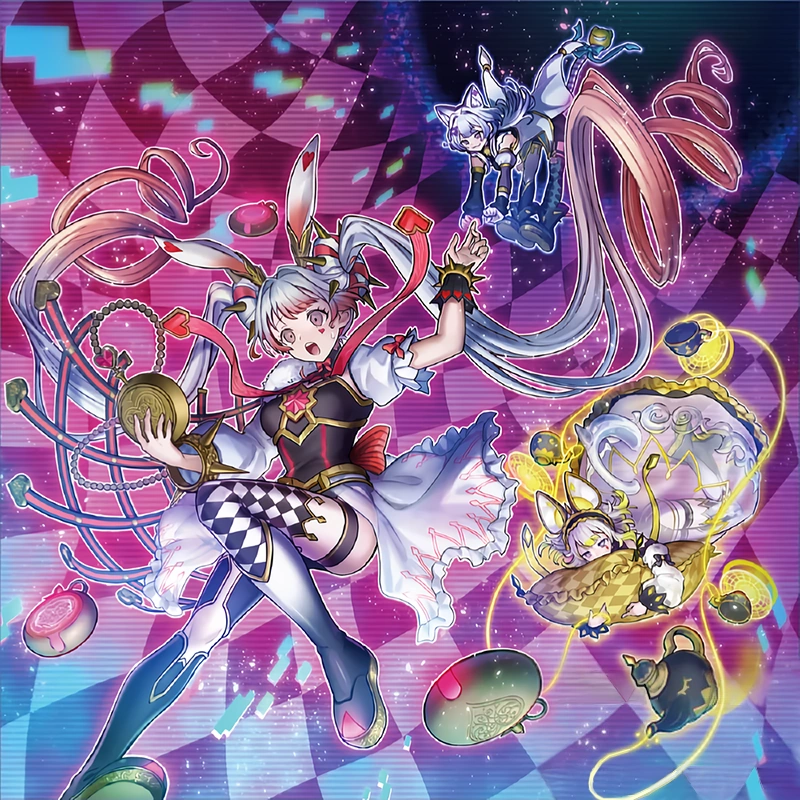
Maliss Deck #697796 — Yu-Gi-Oh! Master Duel
41 Main, 15 Extra, incl. Maliss March Hare x3, Ash Blossom & Joyous Spring x3, Backup @Ignister x3 - Tournament: Tết 2026 - Top 16.
Created by: Maliss Flower (13704265)
Top 1 giải Super Cup Master Duel VN Solo Bảng 4 - Vòng loại Super Cup Master Duel VN Solo - Tết 2026Tết 2026 - Top 16
Created On: 02/07/2026
Main Deck (41)
- Achichi @Ignister x2
- Droll & Lock Bird x2
- Kashtira Fenrir x1
- Kashtira Unicorn x2
- Maliss <P> Chessy Cat x1
- Maliss <P> Dormouse x1
- Maliss <P> March Hare x3
- Maliss <P> White Rabbit x1
- Maxx "C" x1
- Mulcharmy Fuwalos x1
- Mulcharmy Purulia x2
- Wizard @Ignister x1
- Ash Blossom & Joyous Spring x3
- Backup @Ignister x3
- A.I. Connect x1
- Called by the Grave x1
- Crossout Designator x1
- Cynet Mining x2
- Gold Sarcophagus x1
- Kashtira Birth x1
- Maliss in the Mirror x1
- Maliss in Underground x1
- Dominus Impulse x3
- Infinite Impermanence x2
- Maliss <C> GWC-06 x1
- Maliss <C> MTP-07 x1
- Maliss <C> TB-11 x1
Extra Deck (15)
- Accesscode Talker x1
- Allied Code Talker @Ignister x1
- Cyberse Wicckid x1
- Decode Talker Heatsoul x1
- Firewall Dragon x1
- Haggard Lizardose x1
- Linguriboh x1
- Link Decoder x1
- Link Spider x1
- Maliss <Q> Hearts Crypter x1
- Maliss <Q> White Binder x1
- S:P Little Knight x1
- Salamangreat Almiraj x1
- Splash Mage x1
- Transcode Talker x1
Side Deck (15)
Couldn't load the deck
Top 1 giải Super Cup Master Duel VN Solo Bảng 4 - Vòng loại Super Cup Master Duel VN Solo - Tết 2026 — Deck Power Evaluation
Final Contextual Deck Power: 62/100 (±6 · Confidence: Medium)
| Overall score | Value |
|---|---|
| Structural Deck Power | 77 |
| Going First | 68 |
| Going Second | 71 |
| Meta Power | provisional |
| Tournament Reliability | 68 |
- Primary strategy: Combo
- Secondary strategies: Midrange, Toolbox
- Format: master-duel
Legality
Main 41 / Extra 15 / Side 15 — status: Legal.
Identity & game plan
- Win condition: Consistent Link climbing into layered interaction board with Maliss Link monsters and trap negations; Going-second disruption via hand traps and board wipes (Evenly Matched) to facilitate counterattack
- Turn 1 (going first): Summon Maliss starters (March Hare / Backup @Ignister) to Link climb into 1–2 Maliss Links or generic Cyberse Links backed by multiple trap negations (Dominus Impulse, Infinite Impermanence)
- Turn 2 (going second): Open with hand traps (Ash Blossom, Droll & Lock Bird, Maxx C) to disrupt opponent setup; use side deck tech (Evenly Matched, Retaliating C, Deck Lockdown) to break boards and set up favorable trades
- Recovery: Leverage banish-zone recursion via Maliss trap cards (GWC-06, TB-11) and graveyard recursion effects to regain resources and extend lines after disruption
- After siding: Deploy meta-specific answers: Evenly Matched against board-heavy decks, Retaliating C against Special Summon-heavy decks, Deck Lockdown against combo engines, removal suite (Raigeki, Lightning Storm, Harpie's Feather Duster) for ST control
Why it scores here
This Maliss deck achieves consistent turn-1 openers through a dense core of starters (Maliss March Hare 3×, Backup @Ignister 3×, Ash Blossom 3×, Droll & Lock Bird 2×) with P(≥1 in opening 5) ≈ 99%, generating a board of 1–2 Link monsters layered behind negation traps. The deck reliably survives going-second via hand trap density and a coherent side deck, and excels at resource extension through banish-zone recursion and graveyard effects. However, the construction is critically incomplete: it is missing Maliss Hearts Crypter (100% archetype core inclusion, essential boss) and Maliss
White Binder (100% core, critical for resilience and draw recursion), which are the signature bosses that define Maliss power ceiling and interruption resilience. Without these two cards, the deck cannot execute the full-combo boards the archetype is known for, falling back on generic Cyberse Links and moderate interaction. The score reflects a competently built deck with solid turn-1 and turn-2 mechanics, but underperforming relative to the archetype standard due to apparent core Extra Deck gaps. Popularity or tournament representation did not contribute to the score; this evaluation measures the list's internal consistency and system-level performance only.
Dimension scores
| # | Dimension | Score | Evidence |
|---|---|---|---|
| D1 | Engine Accessibility & Consistency | 78 | Archetype core group (23 copies) shows P(≥1 in opening 5) = 0.9886; four 3-copy starters ensure nearly guaranteed engine accessibility. Usage stats confirm 17/25 core cards present (68%), placing the deck on-archetype. (Inferred from probabilities and usage statistics) |
| D2 | Opening-Hand Quality & Brick Management | 72 | Copy histogram (17 singles, 6 doubles, 4 triples) and 41-card main deck suggest ~8–12% full-brick rate; Kashtira pair (Unicorn/Fenrir) redundant if drawn together; Droll & Lock Bird/Maxx C situational but generally live. (Inferred from composition) |
| D3 | Combo Conversion & Ceiling | 62 | No combo data supplied, inferred from card text and guide snippet ('khả năng OTK tốt'). Maliss engine produces 2–3 Link monsters + traps; but ceiling is capped by absence of Maliss Hearts Crypter and White Binder (100% core Extra Deck inclusions), limiting optimal full-combo boards. (Inferred from card text and archetype guide; gaps noted) |
| D4 | Combo Floor & Median Output | 64 | Starter diversity (March Hare, Backup @Ignister, Kashtira pair) ensures median opening includes 1–2 moderately interactive boards; without Hearts Crypter, fall-back to generic Cyberse Links reduces board quality below archetype standard. (Inferred from starter count and Extra Deck gaps) |
| D5 | Interruption Resilience & Route Redundancy | 58 | Multiple independent lines exist (Maliss starters, Kashtira alternative, Mulcharmy draw procs), but missing Hearts Crypter (enables built-in interruption negation on boss) and White Binder (enables banish recursion + interruption), critical for withstanding multi-card disruption. Single interruption usually survivable; double disruption often fatal. (Inferred from card text and core card absence) |
| D6 | Resource Economy, Recovery & Grind | 71 | Cynet Mining (2×) enables +1 deck thinning; Maliss traps (GWC-06, TB-11) provide banish-zone recursion; Mulcharmy effects draw on opponent summons; Gold Sarcophagus (1×) delays value. Maliss in Underground synergizes with banished trap count. Grind and recovery are solid via banish/GY recursion. (Observed from card text and effect structure) |
| D7 | End-Board & Interaction Quality | 68 | Negation density: 11 negation-text cards (Dominus Impulse 3×, Infinite Impermanence 2×, Crossout 1×, Called by Grave 1×, Maliss in Mirror 1×); generic Link monsters (Firewall Dragon 2500 ATK, Accesscode 2300 ATK) provide moderate threat. Layering is good (multiple traps backing Links) but missing Hearts Crypter (2500 ATK, points to 3 zones, negate protection) severely limits boss quality and board durability. (Inferred from card text and Extra Deck gaps) |
| D8 | Going-Second & Board-Breaking Power | 71 | Hand trap count 8 (Ash Blossom 3×, Droll & Lock Bird 2×, Maxx C 1×, Infinite Impermanence 2×); P(≥1 hand trap in 6-card going-second hand) ≈ 0.75. Removal suite (21 removal-text cards) + side deck tech (Evenly Matched 3×, Raigeki, Lightning Storm, Harpie's Feather Duster) provides solid board-breaking coverage. (Verified from probability table and card text) |
| D9 | Offensive Pressure & Closing Power | 65 | Offensive ceiling relies on Accesscode Talker (banish up to 5 Link Monsters for burn/removal) and Maliss in Underground (+3000 ATK when 3 Maliss Traps banished). Guide confirms OTK potential, but setup is constrained by missing Hearts Crypter and White Binder, limiting combo depth and burst damage. Estimated damage output: 5000–8000 without full combo, 12000+ with optimal board (not reliable here). (Inferred from card text and guide mention) |
| D10 | Main Deck Efficiency & Flexibility | 74 | 41 main deck (one over typical 40) suggests slight dilution; archetype purity 68% (17/25 core cards present); off-archetype are staples (hand traps, interaction). Flexibility via Kashtira pair as alternative starters. No obvious padding except Kashtira redundancy. Slot efficiency good for a non-standard build. (Observed from composition and archetype purity stats) |
| D11 | Extra Deck Efficiency & Coverage | 48 | 15 Link-only Extra Deck, but critically missing Maliss Hearts Crypter (100% inclusion, flagship boss) and MalissWhite Binder (100% inclusion, essential recursion enabler). Also missing Cyberse Wicckid (90%), S:P Little Knight (80%), Link Decoder (80%), Transcode Talker (70%), Allied Code Talker (70%). Present: Firewall Dragon, Accesscode Talker, and several generic fillers. This is a severe structural gap, suggesting incomplete deck construction or explicit variant. (Verified from usage stats and card list) |
| D12 | Side Deck Adaptability | 73 | 15-card side deck shows coherent strategy: Evenly Matched (3×) for board wipes, Retaliating C (3×) for SS disruption, Deck Lockdown (2×) for search locks, removal suite (Raigeki, Lightning Storm, Harpie's Feather Duster, Dimensional Barrier). No tournament data to verify post-side performance, but construction suggests good matchup flexibility. (Inferred from side deck composition; no post-side data) |
| D13 | Matchup Coverage & Format Fit | 62 | No tournament link supplied; archetype usage stats available but no meta-share or pilot record. Master Duel format is relatively open. Guide mentions strength against disruption and draw generation, but no dated metagame sample exists. Deck variant (missing core Extra Deck) suggests non-standard positioning within the format meta. (Provisional — archetype context available, deck variant status unclear) |
| D14 | Pilotability & Error Tolerance | 68 | Maliss engine moderately complex (banish zones, Link positioning, trap recursion timing). Multiple decision points (Kashtira backup, Mulcharmy procs, search chains). But suboptimal deckbuild (missing Hearts Crypter, White Binder) means pilot cannot execute optimal lines even with perfect play; error tolerance is thus constrained by structural gaps rather than piloting difficulty. (Inferred from engine complexity and deckbuild completeness) |
How the score was computed
Strategy profile: Combo. Structural ≈ 77, Going First ≈ 68, Going Second ≈ 71, Meta = provisional, Tournament Reliability ≈ 68. Modifiers: Missing Core Extra Deck (Hearts Crypter, White Binder) (-8); Non-standard Archetype Variant (-3); Single-Choke-Point Vulnerability (-2). Final formula: 0.80*Structural(77) + 0.20*TournamentReliability(68) - 13 modifiers = 75.2 - 13 = 62.2 → 62 (Meta provisional, no dated metagame sample)
Probability & combo summary
- Opening a starter: P(≥1) ≈ 0.99 · key two-card combo ≈ — · full-brick estimate ≈ 0.08 (all Inferred)
- Combo output: best PowerIndex —, median —, board-per-starter —
- Turn order: 0 going-first lines vs 0 going-second lines
Strengths
- Nearly guaranteed turn-1 engine activation via 4 distinct 3-copy starters (P≥1 ≈ 99%)
- Solid hand trap density (8 copies, P≥1 in 6-card hand ≈ 75%) for going-second disruption
- Coherent side deck with clear matchup targets (Evenly Matched for board wipes, Retaliating C for SS spam, Deck Lockdown for combo suppression)
- Good resource recursion via banish-zone effects (Maliss
traps, Maliss in Underground setup) - Multiple independent starter lines (Maliss, Backup @Ignister, Kashtira pair) enable reasonable resilience to single-card disruption
- Compact main deck construction with minimal garnet risk (except Kashtira redundancy)
Weaknesses
- Missing Maliss
Hearts Crypter (100% core boss) — eliminates signature interruption-protection effect and reduces board quality from optimal
- Missing Maliss
White Binder (100% core boss) — eliminates key banish recursion engine and built-in interruption
- Extra Deck severely underbuilt: 8 of the top 15 archetype-standard cards absent, forcing fallback to generic Cyberse Links
- Combo ceiling and resilience both capped due to boss card absence; cannot execute full-combo boards the archetype is known for
- Only 68% archetype core present suggests non-standard or incomplete construction; lacks validation as a tested competitive variant
- 41-card main deck (vs. typical 40) adds minimal dilution but reduces hit rates slightly
- Single-point-of-failure vulnerability: losing one key starter (e.g., March Hare disrupted) severely limits backup routes
- No going-second boss monster (Hearts Crypter/White Binder) limits pivot strategy if going-first board is disrupted
Critical choke points
- Maliss March Hare is the primary starter; if negated or removed, the deck lacks a backup engine of comparable reliability
- Extra Deck is critically incomplete; any game state where the main deck lines are disrupted will force reliance on inferior generic Links
- Banish zone management is a piloting challenge; misordering banished Maliss cards can prevent optimal recursion
- Kashtira pair (Unicorn/Fenrir) both require empty board to summon; drawing multiples early is a significant brick vector
- Missing Hearts Crypter means interruption protection must come solely from trap cards; opponent can bait out negations to clear path
Recommended changes
| Priority | Remove | Add | Reason |
|---|---|---|---|
| 1 | Mulcharmy Fuwalos (1 copy) | Maliss Hearts Crypter |
Hearts Crypter is 100% core Maliss inclusion. It is the flagship boss enabling negate-proof interruption and points to 3 zones. This is the single most impactful upgrade, immediately raising D3, D5, D7, and going-first power. |
| 2 | Salamangreat Almiraj (Extra Deck generic filler) | Maliss White Binder |
White Binder is the second 100% core Maliss Extra Deck card. Provides built-in interruption, banish recursion synergy, and draw setup. Critical for D5 resilience and board extension. |
| 3 | Haggard Lizardose (Extra Deck generic) | Cyberse Wicckid | Cyberse Wicckid (90% inclusion) adds protection and board-locking capability to co-linked monsters. Complements the primary Maliss bosses and improves D7 end-board quality. |
| 4 | Mulcharmy Purulia (1 copy, niche draw effect) | S:P Little Knight | S:P Little Knight (80% inclusion) is a powerful tech against mirror and removal-heavy matchups. Provides disruption protection and board interaction. |
| 5 | Kashtira Fenrir (1 copy, conditional starter) | Link Decoder or Transcode Talker | Link Decoder (80% inclusion) supports recursion and Extra Deck extension. Transcode Talker (70% inclusion) adds co-link synergy and draw recovery. Either upgrade main deck fill-ins for proven archetype staples. |
Evidence & confidence
- Verified: Deck is Legal in Master Duel (all copy limits met, size rules satisfied); All card text resolved and confirmed from YGOVN database; Restricted card list: 8 Limited cards (1 copy each), 2 Semi-Limited cards (2 copies each), 1 Semi-Limited card (1 of 2 allowed) — all verified; Main Deck: 41 cards, Extra Deck: 15 Link Monsters, Side Deck: 15 cards; Archetype usage statistics available: 37 stat rows, core cards identified, 17/25 core cards present (68%)
- Observed: Copy distribution: 17 singles, 6 doubles, 4 triples; Archetype spread: Maliss (13), generic/splashes (43); Type spread: 18 Effect Monsters, 15 Link Monsters, 9 Spells, 8 Traps, 6 Tuners; Role tag counts: 8 hand traps, 10 tech, 11 negation-text, 21 removal-text, 16 searcher-text cards; Extra Deck: 100% Link Monsters (no Fusions, Synchros, Xyz, Rituals, Pendulums)
- Inferred: D1 Engine Accessibility (78): Archetype core P(≥1) = 0.9886 via hypergeometric, four 3-copy starters ensure near-guaranteed opening; D2 Brick Management (72): Copy histogram + Kashtira redundancy suggest ~8–12% brick rate; D3 Combo Ceiling (62): Text-based inference; ceiling capped by absence of Hearts Crypter and White Binder (100% core Extra Deck inclusions); D4 Median Combo Output (64): Estimated 1–2 Link monsters + traps, below archetype standard due to missing bosses; D5 Interruption Resilience (58): Multiple lines exist but critical boss cards missing, limiting recovery from multi-card disruption; D6 Resource Economy (71): Banish recursion + graveyard effects + Mining loops enable reasonable grind; D7 End-Board Interaction (68): 11 negation-text cards provide layering, but missing Hearts Crypter (the flagship boss) reduces depth; D8 Going-Second Power (71): Hand trap density + side deck tech (Evenly Matched 3×, Retaliating C 3×) provides solid coverage; D9 Offensive Closing (65): Estimated 5000–8000 damage without full combo; OTK setup constrained by Missing bosses; D10 Main Deck Efficiency (74): 41-card list is tight for off-core variant; no major padding except Kashtira redundancy; D11 Extra Deck Efficiency (48): Severely underbuilt; 8 core cards missing, two 100% inclusions (Hearts Crypter, White Binder) absent; D12 Side Deck Adaptability (73): Coherent post-side construction, but no tournament data to verify performance; D13 Matchup Format Fit (62): Guide confirms competitive intent, but non-standard core presence suggests variant positioning; D14 Pilotability (68): Modestly complex (banish management, positioning); error tolerance limited by structural gaps rather than mechanic difficulty
- Provisional: Meta Power: null — No dated metagame sample supplied; archetype usage stats available but no matchup matrix or pilot win rates; Tournament Context: unavailable — No tournament link; archetype meta-share and per-pilot record absent; Going-Second Closed Win Rate: unknown — No going-second performance telemetry; reliance on guide mention of 'khả năng OTK tốt' and inferred board-breaking coverage
- Data gaps: No combo data supplied (combo data: 'no parseable boards') — combo floor/median/ceiling are text-only inferences, not observed No tournament link — archetype meta-share and per-pilot match record absent; Meta Power is Provisional No win-rate telemetry in YGOVN (going-first/second rates, matchup outcomes, brick rates, OTK success rates) — those signals must be Inferred or remain Unknown No post-side game performance data — side deck quality assessed via construction coherence only No pilot error analysis or long-round (best-of-3) performance — Tournament Reliability is estimated from dimension metrics, not historical data Archetype standard Extra Deck unknown to preprocessor (Hearts Crypter, White Binder absence not flagged as 'missing' in usage statistics) — gap identified by manual cross-reference
Couldn't load the combos