






 WIND
 2
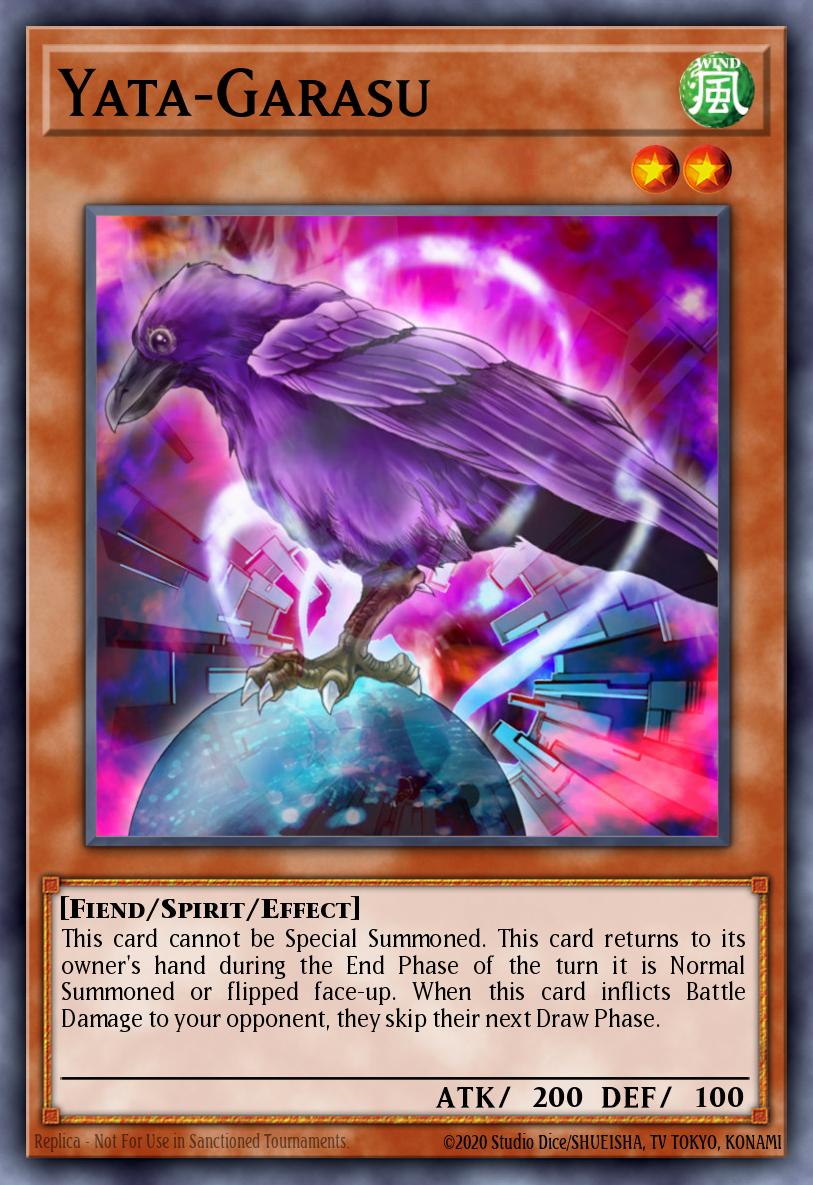
Yata-Garasu
ATK:
200
DEF:
100
View:
9379
This card cannot be Special Summoned. This card returns to its owner's hand during the End Phase of the turn it is Normal Summoned or flipped face-up. When this card inflicts Battle Damage to your opponent, they skip their next Draw Phase.


Yata-Garasu — Power Evaluation
Final Score: 55 ± 8 · Confidence: Medium
- Intrinsic: 56 · Deck: 54 · Meta: provisional
- Primary role: Floodgate/Control · Secondary: Utility
Why it scores here
Yata-Garasu converts its access into a soft tempo effect: a 200/100 Normal-Summon-only body that returns to hand at End Phase and, if it deals battle damage, makes the opponent skip their next Draw Phase. Its ATK and level earn almost nothing, and the 194 decks running it show it is a consistently included staple, which supports accessibility and deckbuilding cost but is not treated as power under guardrail 3. The effect depends on connecting with battle damage and gives no card advantage, so the score stays in the mid-range.
Axis scores
| Axis | Score | Evidence |
|---|---|---|
| Accessibility | 60 | Needs a Normal Summon and has no searcher, but it is run in 194 decks across 58 archetypes, so it is usually reachable (observed; deck count only, no combo starts recorded). |
| Combo & Conversion | 30 | No recorded boards; the card only builds a 200-ATK body and a battle-damage effect, with no extra board or chain from the text (inferred). |
| Resource Economy | 35 | No draw, search, or recursion gain: it returns to hand, so the only value is repeated Normal Summons with no card advantage (verified from text). |
| Effect & Interaction | 45 | The skip-Draw-Phase effect is real but conditional on connecting with battle damage and is easy to stop with a blocker (verified text, inferred impact). |
| Material Utility | 40 | A Level 2 Wind Fiend can serve as material, but it leaves the field at End Phase, so it is awkward to keep as material (inferred from text). |
| Resilience & Flexibility | 45 | Recycles to hand each turn, which protects it from sorcery-type removal, but a single blocker or negation of the effect ends its value (inferred from text). |
| Deck-Building Efficiency | 85 | A 1-copy slot (175 of 194 decks run one), no garnets or locks, and no restriction on the rest of the deck (observed from deck distribution). |
Calculation
Weight profile: 0.7 Floodgate/Control + 0.3 Utility. Intrinsic ≈ 56, Deck ≈ 54, Meta = provisional. Modifiers: none. Final formula: 0.40*Intrinsic + 0.60*Deck
Strengths
- Repeatable Normal Summon body that returns to hand each turn
- Battle-damage effect makes the opponent skip a Draw Phase, a real tempo cost when it connects
- Single-copy, low-cost slot that fits into many archetypes (58 distinct)
Weaknesses
- Cannot be Special Summoned, so it depends on Normal Summon availability
- No card advantage, search, or recursion from its own effect
- Draw-skip effect needs battle damage and is blocked by any blocker
- 200 ATK is too low to attack through most boards
Counters / choke points
- Any blocker that stops battle damage prevents the draw-skip effect
- Effect negation of the battle-damage clause removes its only effect
- Opponents with a stronger board can ignore it entirely
Best use
Floodgate/Control (battle-damage draw skip) with repeatable Normal Summon pressure. Decks: Black Luster Soldier, D/D/D, Jinzo. Suggested copies: 1.
Evidence & gaps
- Verified: Normal Summon only; returns to hand at End Phase of the turn it is Normal Summoned or flipped; If it inflicts battle damage, the opponent skips their next Draw Phase; Level 2 Wind Fiend, 200 ATK / 100 DEF; 175 of 194 decks run 1 copy (avg 1.16)
- Observed: Appears in 194 decks across 58 distinct archetypes; Harpie's Feather Duster co-occurs in 54.1% of its decks; No combo boards recorded, so combo conversion is not measured
- Inferred: The draw-skip effect is conditional on battle damage, so it is not reliable against a blocker; The bounce lets it be Normal Summoned again each turn, giving repeated pressure at no card cost; As material it leaves the field at End Phase, which makes it awkward
- Data gaps: no combos supplied, so combo conversion is text-only inference no guides supplied no usage statistics (StatisticsCard), so archetype inclusion is inferred from the deck sample only