






 Trap
 Counter
Wiretap
View:
3570
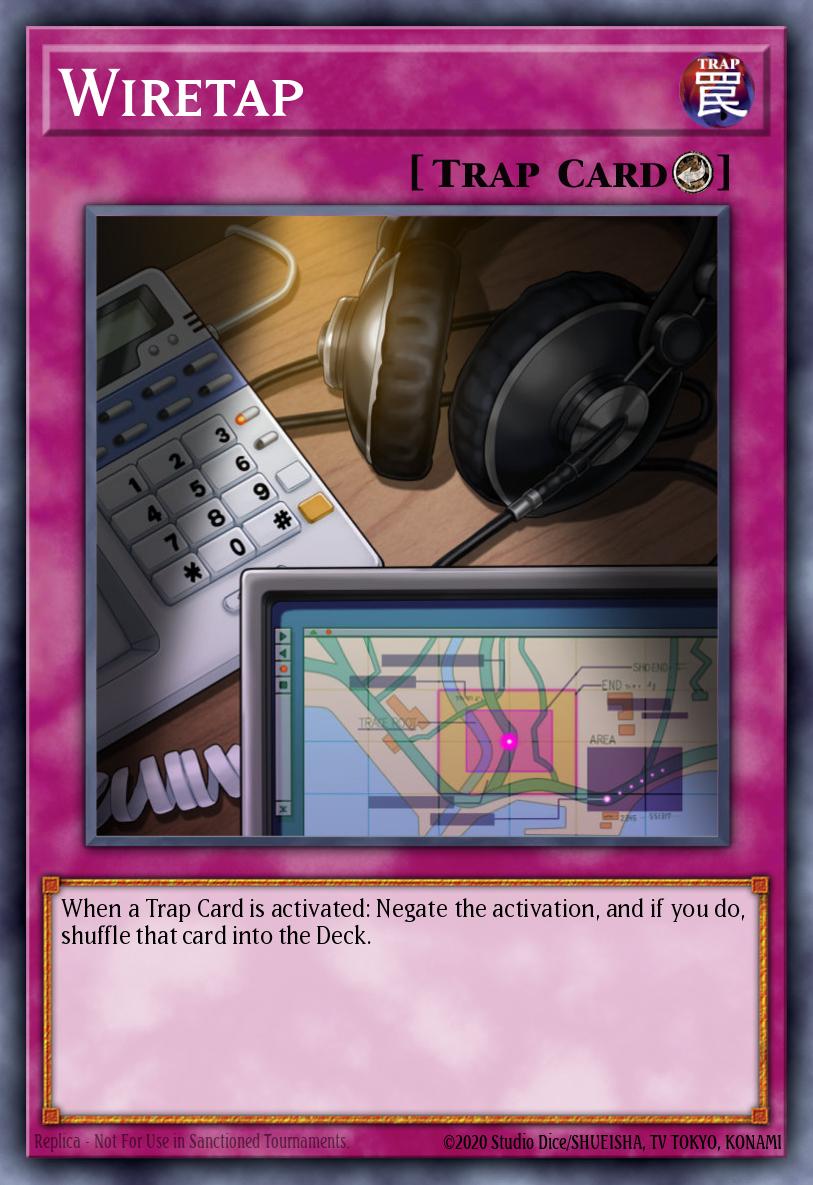
When a Trap Card is activated: Negate the activation, and if you do, shuffle that card into the Deck.
Wiretap — Power Evaluation
Final Score: 57 ± 6 · Confidence: Medium
- Intrinsic: 56 · Deck: 58 · Meta: provisional
- Primary role: Negation/Interaction
Why it scores here
Wiretap is a generic Trap-activation negate that returns itself to the Deck, so it converts a single set trap into one negated Trap activation with no card advantage and no board. Its score comes almost entirely from interaction and cheap, flexible deck-building: 296 recent decks across 120 archetypes at about 1.7 copies each confirm it is a practical, portable staple, but guardrail 3 means that frequency did not raise the score. It has no combo data, no material value and no body, so those axes stay low.
Axis scores
| Axis | Score | Evidence |
|---|---|---|
| Accessibility | 55 | Must be set as a Trap, so it is not live in hand; it is reached through set-and-wait rather than a searcher, and no searcher route is in the evidence (inferred, from text and deck spread). |
| Combo & Conversion | 15 | Zero recorded combo appearances and no starter, searched or payoff role; scored from text alone as a non-building interaction card (inferred, no combo data). |
| Resource Economy | 50 | Negates one Trap activation and shuffles itself back into the Deck, so it is roughly even rather than card-advantage positive (inferred from text). |
| Effect & Interaction | 60 | Negates any Trap Card activation, a broad but Trap-only scope that is hard to play around for Trap-using decks (verified from card text; scope limit inferred). |
| Material Utility | 0 | A Trap Card cannot be used as Link, Xyz, Synchro or Fusion material, so it provides no material value (verified from card type). |
| Resilience & Flexibility | 35 | Set-backrow card that is vulnerable to backrow removal before use, with the shuffle-back offering some recovery; no redundancy beyond copies (inferred from text). |
| Deck-Building Efficiency | 75 | Runs at 1 to 3 copies in 296 decks with no garnet or lock restriction, so it is cheap and easy to run (observed from deck copy distribution). |
Calculation
Weight profile: Primary role Negation/Interaction (Removal/Negation profile); no secondary role blended. Intrinsic ≈ 56, Deck ≈ 58, Meta = provisional. Modifiers: none. Final formula: 0.40*Intrinsic + 0.60*Deck
Strengths
- Negates any Trap Card activation, with the card returning to the Deck rather than the Graveyard
- Cheap and easy to run: 1 to 3 copies in most decks with no restriction
- Portable across 120 archetypes and four gameplay types
Weaknesses
- Trap-only scope: no effect against Monsters, Spells, or monster effects
- Must be set first, so it is not live in hand and is exposed to backrow removal
- No card advantage, no body, and no material value
Counters / choke points
- Decks that run few or no Trap Cards
- Backrow removal used before the trap is needed
Best use
Trap-activation negation and backrow interaction. Decks: Solemn, Traptrix, Dinomorphia, Artifact. Suggested copies: 2.
Evidence & gaps
- Verified: Card text: negates a Trap Card activation and shuffles itself into the Deck if it does; Trap Card type cannot serve as material; 296 recent decks, average 1.69 copies, max 3; Top partner Solemn Warning in 44.3% of decks
- Observed: Gameplay type 7 in 61.1% of decks and type 4 in 33.8%; Solemn inclusion 66.7% with typical 2 copies in usage statistics
- Inferred: Accessibility depends on setting the card and having it survive the turn, with no searcher route in the evidence; Negation scope is limited to Trap activations, which makes it weaker against non-Trap interaction; Resilience is limited by backrow removal before use
- Data gaps: no combos supplied: combo conversion is text-only inference no guides supplied no banlist token: assumed 3 copies (unlimited) no dated metagame sample: Meta is null legal_copies is empty, so per-format legality is unverified