






 Trap
 Normal
Weighbridge
View:
3930
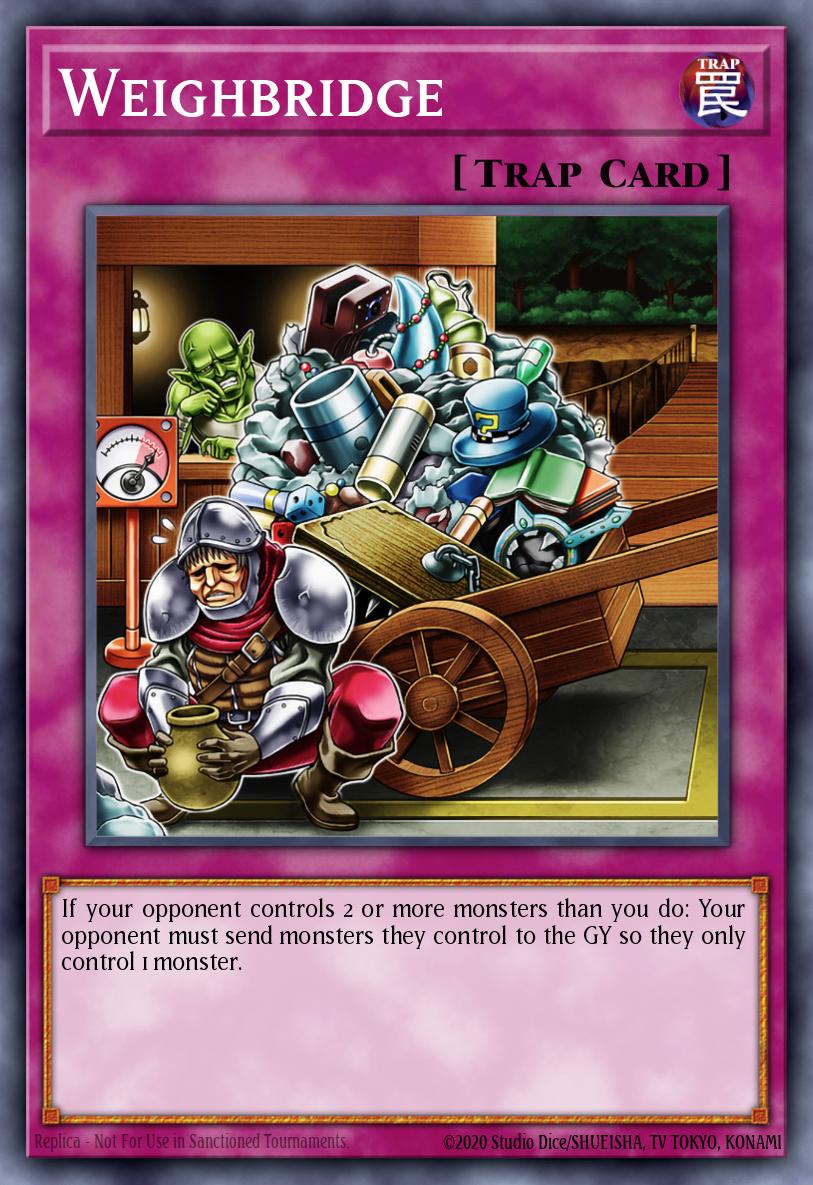
If your opponent controls 2 or more monsters than you do: Your opponent must send monsters they control to the GY so they only control 1 monster.
Weighbridge — Power Evaluation
Final Score: 60 ± 8 · Confidence: Medium
- Intrinsic: 60 · Deck: 60.5 · Meta: provisional
- Primary role: Board breaker / Going-second · Secondary: Floodgate/Control, Removal
Why it scores here
Weighbridge is a normal Trap whose conditional effect forces an opponent holding two or more extra monsters down to one monster in the GY. Its score comes from that interaction, not from any ATK or DEF, and the deck evidence (running in all 400 sampled decks at about 1.26 copies each) confirms it is a reliable, cheap, and live backrow slot. The main limits are the conditional activation and the lack of combo or resource evidence, so it is not rated higher.
Axis scores
| Axis | Score | Evidence |
|---|---|---|
| Accessibility | 72 | Runs in all 400 sampled decks across 59 archetypes, so it is usually live once drawn, but there is no searcher or combo-start evidence (observed + inferred). |
| Combo & Conversion | 40 | No combo boards recorded; the card only converts an existing monster lead into a board reset, not into a multi-step line (inferred from text). |
| Resource Economy | 35 | Sends opponent monsters to the GY with no card advantage returned to the user, so value is one-sided disruption (verified from text). |
| Effect & Interaction | 68 | Strong monster-count sweep that is hard to play around when the opponent is over-extended, but it only triggers under the 2-or-more monster condition (verified from text + observed deck use). |
| Material Utility | 5 | A Trap card with no material or name-providing body, so it contributes nothing to Extra Deck summoning (verified from text). |
| Resilience & Flexibility | 45 | Conditional trigger and a single backrow body mean a hand trap or simple monster-count change can shut it off; redundancy across decks helps only a little (inferred). |
| Deck-Building Efficiency | 70 | Average 1.26 copies per deck with no garnet or self-lock; a single trap slot is cheap to run (observed + verified from text). |
Calculation
Weight profile: Board breaker / Going-second profile, single primary role (no blend). Intrinsic ≈ 60, Deck ≈ 60.5, Meta = provisional. Modifiers: none. Final formula: 0.40*Intrinsic + 0.60*Deck
Strengths
- Cheap, legal in TCG/OCG/MasterDuel, and runs at about one copy per deck
- Strong disruption when the opponent is over-extended
- Broad archetype reach (59 archetypes in the sample)
Weaknesses
- Conditional on the opponent controlling two or more extra monsters
- No card advantage or recursion
- Zero material value
Counters / choke points
- Monster-count changes or pre-emptive plays that keep the opponent's extra monsters below the threshold
- Hand traps that negate or pre-empt the trap activation
Best use
Board breaker / Going-second. Decks: Labrynth, Dogmatika, Traptrix, Knightmare. Suggested copies: 1.
Evidence & gaps
- Verified: Trap card text: opponent with 2+ more monsters must send monsters to GY until they control 1; Legal in TCG, OCG, and MasterDuel; No material or name-providing body
- Observed: Runs in 400/400 sampled decks at 1.26 avg copies; Spread across 59 archetypes, most in Labrynth, Dogmatika, Traptrix, Knightmare
- Inferred: Accessibility is live once drawn but has no searcher route; Resilience is limited by the conditional trigger and hand-trap exposure
- Data gaps: no combos supplied — combo conversion is text-only inference no guides supplied no banlist token — assumed 3 copies (unlimited) no usage statistics (StatisticsCard) — archetype inclusion % inferred from deck sample only