






 DARK

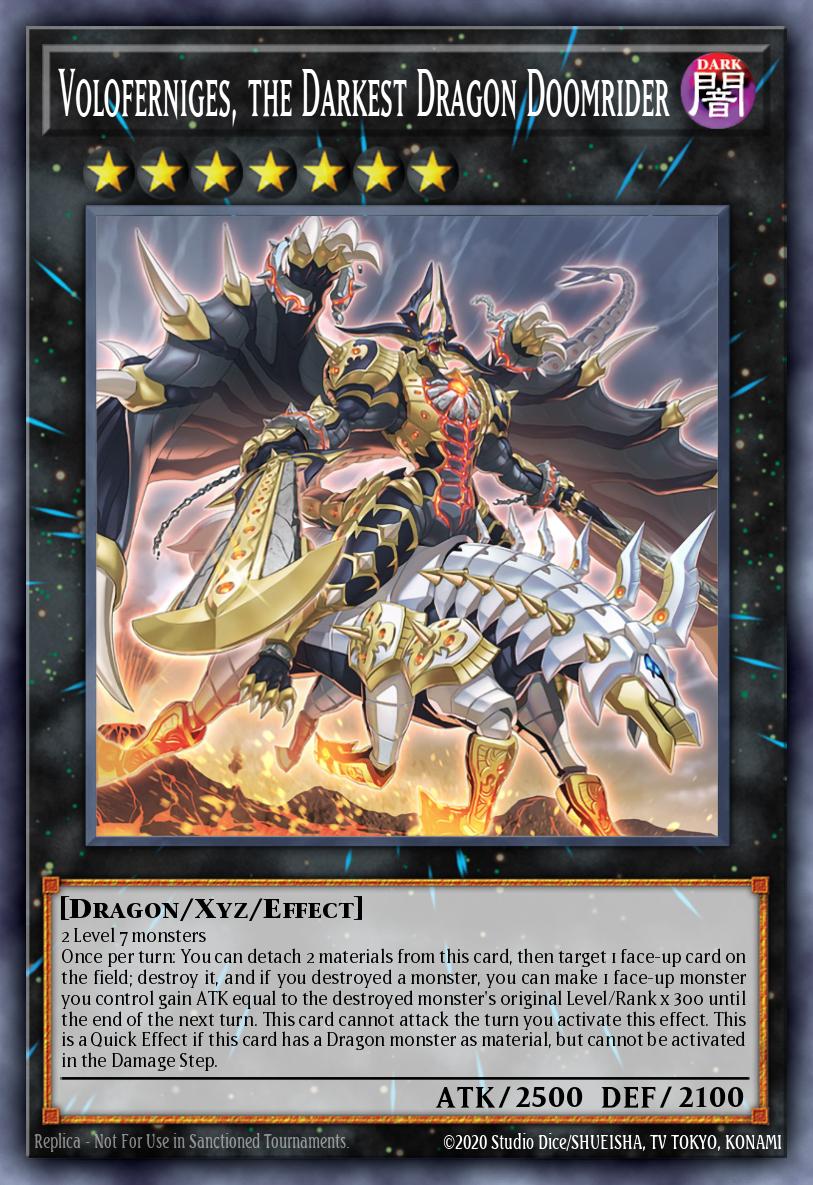
Voloferniges, the Darkest Dragon Doomrider
ATK:
2500
DEF:
2100
View:
5213
2 Level 7 monsters Once per turn: You can detach 2 materials from this card, then target 1 face-up card on the field; destroy it, and if you destroyed a monster, you can make 1 face-up monster you control gain ATK equal to the destroyed monster's original Level/Rank x 300 until the end of the next turn. This card cannot attack the turn you activate this effect. This is a Quick Effect if this card has a Dragon monster as material, but cannot be activated in the Damage Step.
Voloferniges, the Darkest Dragon Doomrider — Power Evaluation
Final Score: 61 ± 6 · Confidence: Medium
- Intrinsic: 59 · Deck: 62 · Meta: provisional
- Primary role: Removal · Secondary: Boss/End-board
Why it scores here
Voloferniges converts two Level 7 Xyz materials into one targeted destruction of any face-up card, plus an ATK boost if a monster was destroyed. Its score is driven by that flexible, once-per-turn removal (effect_interaction) and by the fact that it is live in all 400 sampled decks, mostly Dragon Ruler shells. It does not score on its 2500 ATK: the material cost is a net -2 with no card advantage, and the card has no recorded combo appearances, so combo_conversion rests on text alone.
Axis scores
| Axis | Score | Evidence |
|---|---|---|
| Accessibility | 58 | Live in all 400 sampled decks across 44 archetypes, but needs a Level 7 pair to summon (verified deck stats, inference on the summon route) (observed). |
| Combo & Conversion | 45 | Text shows one removal plus an optional ATK buff, with no recorded combo boards to confirm a payoff (inferred). |
| Resource Economy | 35 | Detaches 2 materials for at most one destruction and draws nothing, so the net is negative (verified card text). |
| Effect & Interaction | 68 | Destroys any face-up card once per turn, so it is flexible and hard to play around, but it is target-based and can be responded to (verified card text). |
| Material Utility | 35 | Rank 7 Dragon Xyz with limited material use; its usefulness as material for other Xyz is not evidenced (inferred). |
| Resilience & Flexibility | 45 | Once-per-turn, targeted, and negatable, with a Quick Effect clause only when a Dragon is a material; it has no recursion (verified card text). |
| Deck-Building Efficiency | 70 | One copy per deck in all 400 sampled decks, no garnet or lock restriction, but tied to Dragon Level 7 material (observed deck stats). |
Calculation
Weight profile: 0.7 Removal + 0.3 Boss/End-board. Intrinsic ≈ 59, Deck ≈ 62, Meta = provisional. Modifiers: none. Final formula: 0.40*Intrinsic + 0.60*Deck
Strengths
- Flexible once-per-turn targeted removal that can hit any face-up card
- Live in 400 of 400 sampled decks across 44 archetypes, with strong Dragon Ruler pairing
- Single-copy, no garnet, easy to run
Weaknesses
- Costs 2 materials for at most one destruction, so card economy is negative
- No recorded combo appearances, so combo conversion is text-only inference
- Needs a Level 7 pair to summon and a Dragon for the Quick Effect
Counters / choke points
- Negation of the activation (opponent Effect negation)
- Removal or bounce of the Xyz before it activates
- Material removal in response to the activation
Best use
Removal with a Boss/End-board finisher role. Decks: Dragon Ruler, Armed Dragon, Red-Eyes, Rose Dragon. Suggested copies: 1.
Evidence & gaps
- Verified: Costs 2 materials, once per turn, targets any face-up card to destroy it; Gains ATK equal to the destroyed monster's original Level/Rank x 300 if a monster was destroyed; Single copy in all 400 sampled decks
- Observed: Present in 400 of 400 sampled decks, 44 distinct archetypes; Top partners appear in 50-72% of decks with this card
- Inferred: Summon route needs a Level 7 pair; Material value for other Xyz is limited
- Data gaps: no combos supplied, so combo conversion is text-only inference no banlist token, so 3 copies assumed no usage statistics (StatisticsCard), so archetype inclusion is inferred from the deck sample only