






 Trap
 Continuous
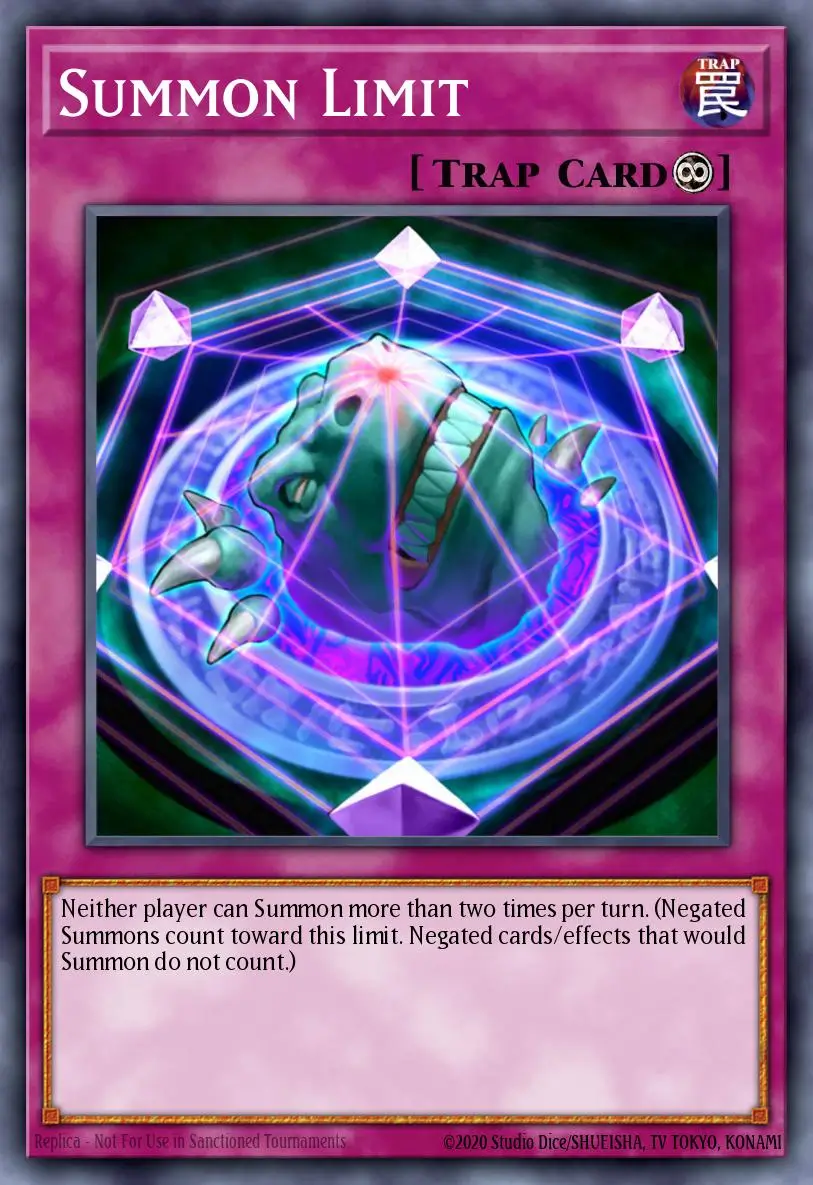
Summon Limit
View:
11417
Neither player can Summon more than two times per turn. (Negated Summons count toward this limit. Negated cards/effects that would Summon do not count.)


Summon Limit — Power Evaluation
Final Score: 48 ± 8 · Confidence: Medium
- Intrinsic: 52.6 · Deck: 44.8 · Meta: provisional
- Primary role: Floodgate/Control
Why it scores here
Summon Limit is a continuous floodgate: it caps both players at two Summons per turn, so its value comes from effect_interaction and the way it restricts the opponent's board development. It builds nothing, gains no card advantage, and is not a material body, so those axes stay low. Its high deck count and popularity do not earn points on their own (guardrail 3); the score rests on the text-verified floodgate effect and the intrinsic axes. The 400-deck sample conflicts with legal copies = 0 in every format, so the deck and final scores are discounted by a provisional -3 modifier until the legality data is verified.
Axis scores
| Axis | Score | Evidence |
|---|---|---|
| Accessibility | 55 | A continuous trap that must be set and stays on the field; it is routinely run at one copy, but there is no combo-level starter or searched data (inferred from text and deck stats). |
| Combo & Conversion | 10 | No combo boards recorded and the card creates no bodies or payoffs; it only restricts Summons (verified from text, combo data total combos 0). |
| Resource Economy | 15 | The card generates no card advantage, draws, or recursion; its only resource effect is denying Summons (verified from text). |
| Effect & Interaction | 55 | Applies a symmetric, always-on Summon cap that hits both players; it is a floodgate rather than a flexible negation, and only partly hard to play around (verified from text, inferred for strength). |
| Material Utility | 5 | Not a monster and cannot be used as material, so this axis is near zero (verified from card type). |
| Resilience & Flexibility | 40 | Persists on the field but is exposed to backrow removal and destruction; no redundancy beyond one copy (inferred from text and frame type). |
| Deck-Building Efficiency | 60 | Single-copy, low-slot cost with no garnet or lock on the rest of the deck, though the Summon cap also restricts the owner (verified from deck copies distribution, inferred for the restriction cost). |
Calculation
Weight profile: Floodgate/Control primary role, no secondary. Intrinsic ≈ 52.6, Deck ≈ 44.8, Meta = provisional. Modifiers: Legality conflict (-3). Final formula: 0.40*Intrinsic + 0.60*Deck
Strengths
- Hard, symmetric Summon cap that disrupts Extra Deck and multi-Summon lines (verified from text).
- Cheap single-copy slot with no garnet or lock requirement (verified from copies distribution).
- Broad archetype spread across 115 distinct archetypes suggests a generic home (observed, from deck data).
Weaknesses
- Builds no board and produces no advantage; combo_conversion and resource_economy are near zero (verified from combo data and text).
- Not a body, so no material value (verified from card type).
- Symmetric restriction also limits its own deck (inferred from text).
Counters / choke points
- Backrow removal or destruction of the continuous trap (inferred from card type).
- Opponent plays around the cap by spreading Summons across turns (inferred).
Best use
Floodgate/Control. Decks: Floodgate or control shells that rely on restricting opponent Summons. Suggested copies: 1.
Evidence & gaps
- Verified: Continuous trap: two Summons per turn cap for both players, negated Summons count (card text).; legal copies is 0 in TCG, OCG and MasterDuel (evidence.card.legal copies).; Zero combo appearances (combo data.total combos = 0).
- Observed: Appears in 400 of 400 sampled decks, 377 at one copy (deck data).; Gameplay type 7 accounts for 94% of decks (deck data).
- Inferred: Floodgate role and symmetric restriction cost (from text and role hints).; Strength of interaction limited to a soft cap (inferred from text).
- Data gaps: no combos supplied: combo conversion is text-only inference no usage statistics (StatisticsCard): archetype inclusion inferred from the deck sample only legal copies is 0 in every format while deck data shows 400 decks running the card; the legality or matching data needs checking near-universal partners (Maxx C 84%, Ash Blossom 74%) suggest the deck match may be a staple artefact