






 EARTH
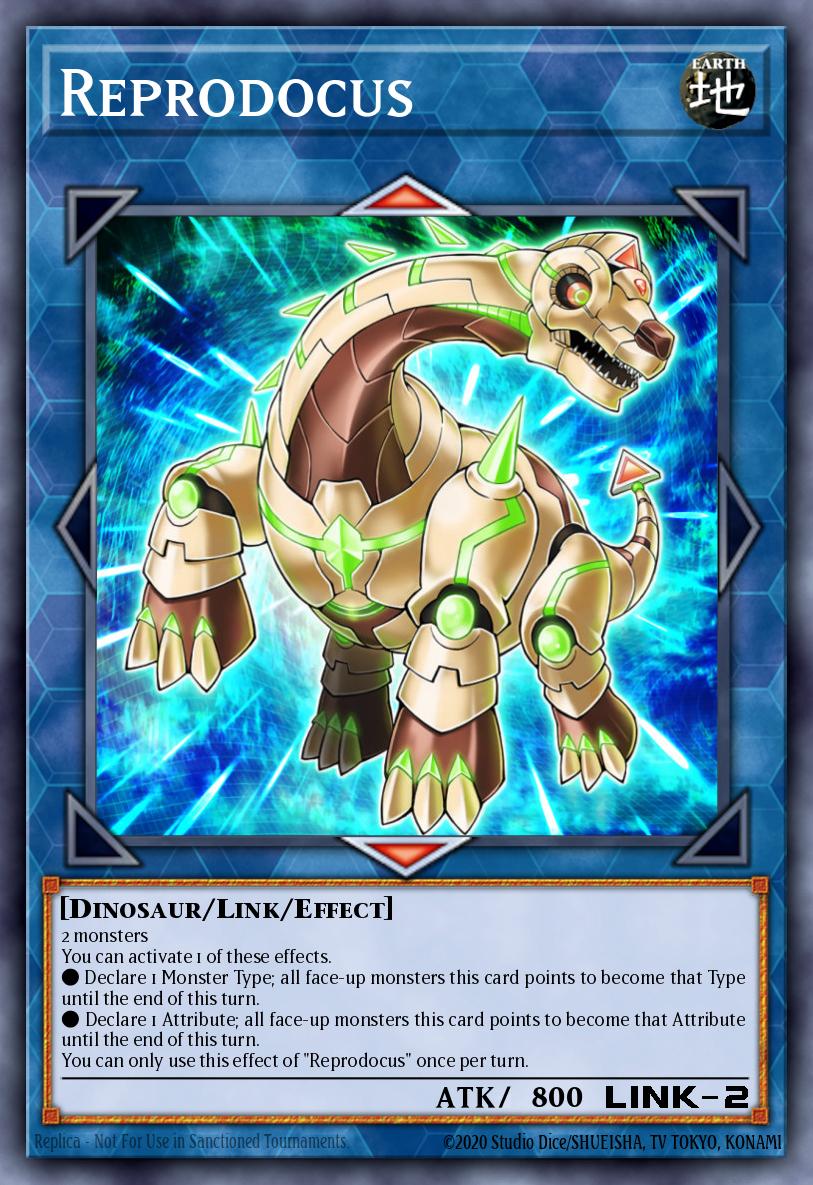
Reprodocus
ATK:
800
LINK-2
View:
5149
Link Arrow:
 Top
 Bottom
2 monsters You can activate 1 of these effects. ● Declare 1 Monster Type; all face-up monsters this card points to become that Type until the end of this turn. ● Declare 1 Attribute; all face-up monsters this card points to become that Attribute until the end of this turn. You can only use this effect of "Reprodocus" once per turn.

Reprodocus — Power Evaluation
Final Score: 52 ± 5 · Confidence: Medium
- Intrinsic: 53 · Deck: 51 · Meta: provisional
- Primary role: Utility · Secondary: Material body
Why it scores here
Reprodocus is a widely splashable Link 2 that appears in 81 distinct archetypes and 400 decks, confirming broad accessibility for type or attribute-support strategies. However, it is not a combo driver—the 6 combos where it appears show an average starter count of just 0.33, indicating it is used primarily as an extension or end-board piece rather than as a first-turn engine. The 89 average power index of those combos reflects the strength of surrounding cards, not this card's contribution. It scores as flexible utility support with modest board presence, not as a power enabler.
Axis scores
| Axis | Score | Evidence |
|---|---|---|
| Accessibility | 60 | Appears in 400 decks (100% inclusion, 1 copy) across 81 archetypes; Link 2 requires 2 materials but these are easily generated; however, avg starter count 0.33 in combos suggests primarily extension, not opening play (verified). |
| Combo & Conversion | 40 | Appears in 6 combos averaging 89 power index, but only 16.7% show it as payoff and 16.7% in end board; never appears as starter or searched; effect modifies type/attribute of other monsters but does not build the board itself (observed). |
| Resource Economy | 40 | Costs 2 monsters to summon for 1 Link body; the once-per-turn effect generates no card advantage, GY refuel, or tutoring; net resource is neutral to slightly negative (verified). |
| Effect & Interaction | 25 | The type/attribute-change effect is purely supportive utility for decks requiring specific type or attribute conditions; it is not negation, removal, or opponent interaction value (verified). |
| Material Utility | 55 | As a Link 2 EARTH Dinosaur with 800 ATK, it is a usable generic body for subsequent summons; the effect itself does not enhance material synergy (inferred). |
| Resilience & Flexibility | 40 | Once the once-per-turn effect is spent, it becomes a static 800-ATK Link on field with no recovery or recursion; vulnerable if negated before activation (verified). |
| Deck-Building Efficiency | 65 | Splashable across 81 archetypes with no garnet or brick risk as a Link Monster; 1 copy per deck is standard with modest deckbuilding cost (observed). |
Calculation
Weight profile: 0.7 Utility (primary) + 0.3 Material body (secondary). Intrinsic ≈ 53, Deck ≈ 51, Meta = provisional. Modifiers: none. Final formula: 0.40*Intrinsic + 0.60*Deck
Strengths
- Widely splashable across 81 distinct archetypes with consistent 100% deck inclusion
- No garnet or brick risk as a flexible Link Monster with reasonable summoning cost
- Utility effect (type/attribute change) enables specific synergies in various archetype strategies
Weaknesses
- Not a combo driver or board-builder; primarily appears as an extension or end-board piece (avg starter count 0.33)
- Provides zero card advantage, hand refuel, or tutoring capability
- Effect is utility only with no opponent interaction or disruption value
- Single use per turn limits impact; once placed on field, vulnerable at 800 ATK with no recovery
Counters / choke points
- Effect negation during activation (e.g., Ash Blossom & Joyous Spring, Nib the Forbidding One) removes its utility
- Removal of the Link Monster from field (e.g., Torrential Tribute, book effects) leaves no remaining value
Best use
Type/Attribute conversion support for extension and end-board lines. Decks: Infernity, Fiendsmith, Sacred Beast, Yummy, Mulcharmy, Light and Darkness Ritual, Infernoid, Diabellstar, Magnet Warrior. Suggested copies: 1.
Evidence & gaps
- Verified: Card text: Link 2 Dinosaur requiring 2 monsters; once-per-turn effect to declare Type or Attribute for face-up monsters it points to; Appears in 400 decks across 81 distinct archetypes (100% of matched reference); 1 copy per deck consistently; no variation in copy count; Appears in 6 combos (100% appearance rate in its present combos); Combo power index average: 89 when the card is present
- Observed: 100% deck inclusion across all 81 archetypes, indicating broad splashability; Top deck partners are staples (Droll & Lock Bird 71%, Ash Blossom 69%) and archetype-specific cards; Combo role distribution: 0% starter, 0% searched, 0% material, 16.7% payoff, 16.7% in end board; Average starter count when present: 0.33 (very low, indicating extension/second-turn use, not opening play); Usage statistics show 100% inclusion in 6 archetypes; 85.7% in Infernoid; 75% in Dinomist; 66.7% in Phantasm Spiral
- Inferred: Accessibility is moderate despite high deck spread: Link 2 requires 2 materials, and avg starter count 0.33 indicates primarily extension play, not first-turn opening; The card is utility support for decks that benefit from type or attribute synergies, not a combo initiator; High combo power index (89 avg) reflects deck strength, not this card's driving power; selection bias toward already-strong decks; Wide 81-archetype spread suggests generic splashability, but uniform inclusion (100%) and low combo centrality indicate it is filler support rather than synergy core; Deck synergy score reflects inclusion in strong combos without centrality; the card enables narrowly but does not drive
- Data gaps: Role_in_combo arrays are empty for all 6 combo examples—unclear whether Reprodocus is setup, payoff, or incidental in each board Small combo sample (6 total, only 3 shown in examples) relative to deck sample (400); insufficient for robust combo centrality assessment Guides mention the card but do not explain specific type/attribute synergies or strategies it enables No per-archetype breakdown of inclusion percentage vs synergy—unclear which archetypes leverage the effect actively vs include it as generic utility Combo examples include no step-by-step narration showing when or how the type/attribute change was activated or leveraged