






 Spell
 Normal
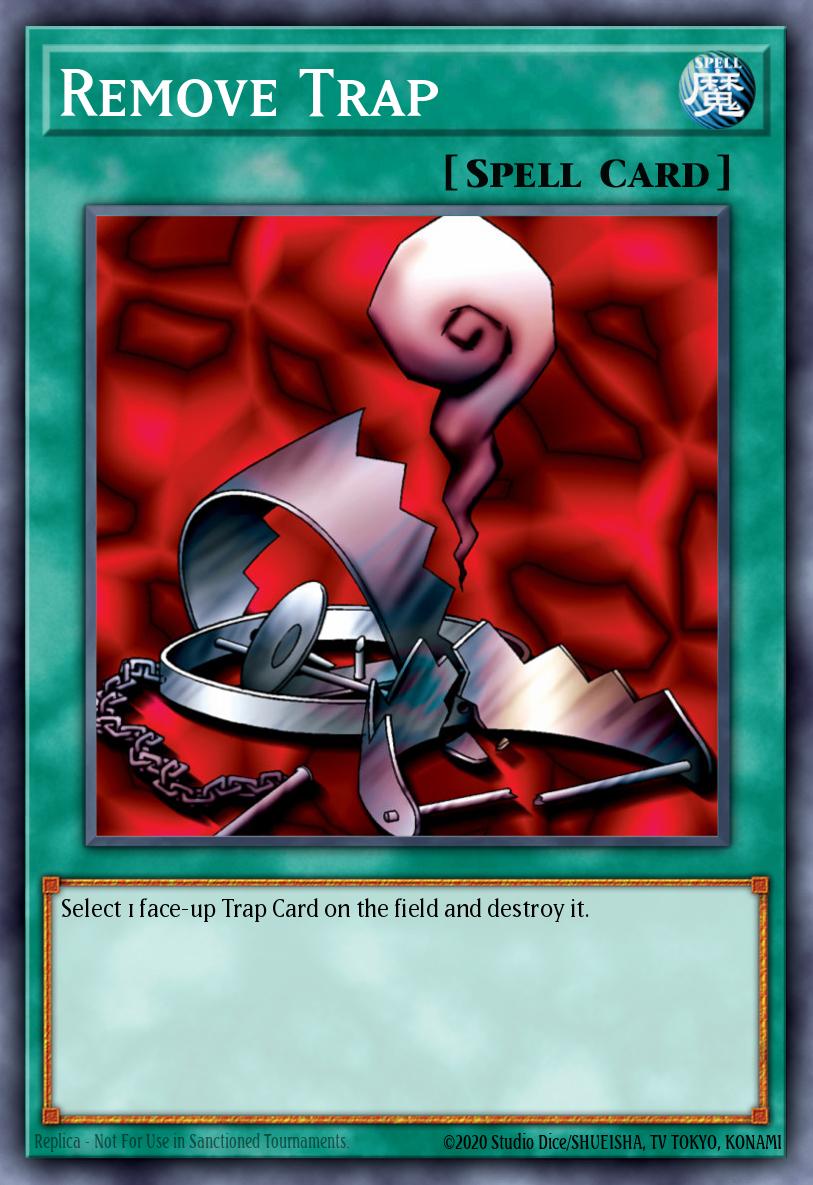
Remove Trap
View:
5656
Select 1 face-up Trap Card on the field and destroy it.
Remove Trap — Power Evaluation
Final Score: 45 ± 6 · Confidence: Medium
- Intrinsic: 48 · Deck: 47 · Meta: provisional
- Primary role: Removal · Secondary: Board breaker
Why it scores here
Remove Trap is a conditional removal tool that cleanly destroys face-up Trap Cards, making it a situational but valued tech in Trap-heavy control decks like Greed and Hole. However, its utility is entirely dependent on the opponent playing Traps, and it generates neither card advantage nor combo value. The card's low accessibility (not searchable, requires specific board state), minimal resilience, and zero combo conversion prevent a higher score. It scores in the mid-40s because it delivers solid disruption in its intended matchups but severe limitations in flexibility and meta-independence cap its power.
Axis scores
| Axis | Score | Evidence |
|---|---|---|
| Accessibility | 38 | Not searchable and requires opponent Trap on field; deck evidence shows 44 inclusions across 18 archetypes at 1-3 copies, primarily as conditional tech (verified) |
| Combo & Conversion | 5 | Appears in zero combo boards and generates no card advantage or field development; purely single Trap destruction with no synergy (verified) |
| Resource Economy | 45 | Trades 1 card to destroy 1 opponent Trap, yielding even resource economy in Trap matchups but acting as a brick in non-Trap archetypes (inferred) |
| Effect & Interaction | 52 | Provides solid disruption by removing face-up Traps like Mirror Force and Swords of Revealing Light, but is entirely Trap-specific and useless against non-Trap decks (observed) |
| Material Utility | 1 | Spell Cards cannot be Synchro/Xyz/Fusion material and no effects use Spells as material; essentially zero utility as a body (verified) |
| Resilience & Flexibility | 35 | One-use, single-zone card with no recovery or multi-turn utility; resolves and disappears with no backup lines (inferred) |
| Deck-Building Efficiency | 48 | No archetype-specific locks, but acts as a conditional brick in non-Trap matchups; running 1-3 copies is viable but matchup-dependent (observed) |
Calculation
Weight profile: Primary role: Removal / Negation. Intrinsic ≈ 48, Deck ≈ 47, Meta = provisional. Modifiers: Conditional utility (Trap-meta dependent) (-2). Final formula: 0.40*Intrinsic + 0.60*Deck
Strengths
- Clean removal effect with no timing complexity or edge cases
- Efficient destruction of problematic face-up Traps like Mirror Force and floodgates
- Broad archetype coverage across 18 distinct Trap-focused decks (Greed, Hole, Gladiator Beast, Ninja, Umi Control, Masked HERO)
- No self-locking effects or deck restrictions
Weaknesses
- Entirely dependent on opponent Trap play; useless if opponent runs minimal or no Traps
- No card advantage, no combo value, no deck cycling or refuel
- Not searchable; limited accessibility without specific board state
- Acts as a brick in opening hand before Traps are established
Counters / choke points
- Decks running no or minimal Trap Cards (pure combo/control decks, spell-heavy control)
Best use
Removal (face-up Trap destruction). Decks: Greed Control, Hole Control, Gladiator Beast, Umi Control, Trap-focused Control.
Evidence & gaps
- Verified: Card text: Normal Spell that destroys one face-up Trap Card (from card description); Deck presence: 44 decks across 18 archetypes with 1-3 copies (avg 1.75) (from deck data); Main deck only: zero side deck inclusions (from deck data); Top archetypes: Greed 18.2%, Hole 13.6%, Gladiator Beast 4.5%, Ninja 4.5% (from deck data); Top partners are Trap cards (Mirror Force, Trap Hole) and control staples (Monster Reborn, Swords of Revealing Light) (from deck data)
- Observed: Appears in 18 distinct archetypes indicating portability across multiple Trap-focused homes (from deck data); Runs primarily as main-deck tech in control strategies, not side deck (from deck data); Consistently paired with other Trap-focused cards and board-wipe staples (from deck data)
- Inferred: Requires opponent Trap on field to be useful; conditional activation trigger (from card text); Zero combo synergy; intended as narrow utility removal, not a line starter (from 0 combo appearances + text); Matches-dependent card; strong in Trap-heavy metas, dead in pure combo decks (from archetype distribution + text)
- Data gaps: No combos supplied — combo conversion is text-only inference No guides supplied — no strategic context or expert perspective No banlist token — assumed unlimited (3 copies legal) No usage statistics (StatisticsCard rows) — archetype inclusion percentages inferred from 44-deck sample only No metagame context — cannot assess relative prevalence of Trap decks in current format No ruling clarifications — Trap Monster vs. Trap Card edge case not addressed