






 Spell
 Continuous
Prohibition
View:
7153
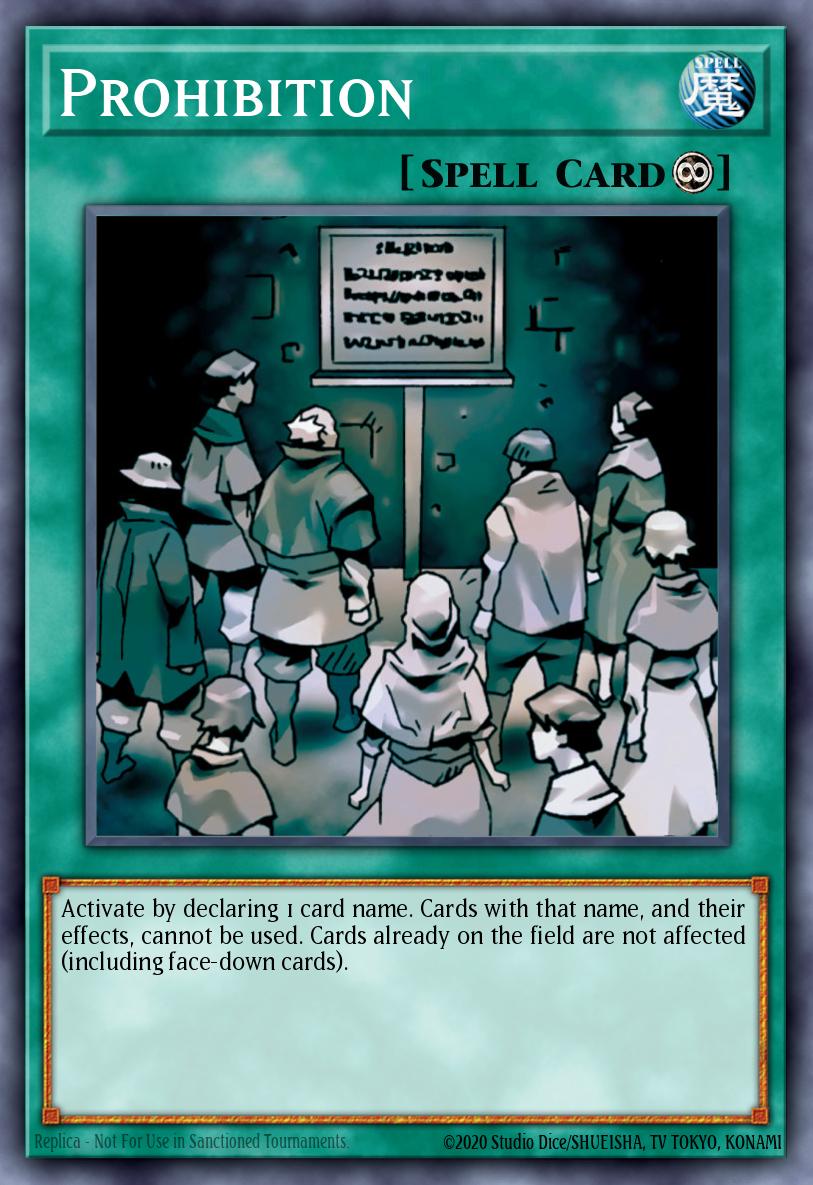
Activate by declaring 1 card name. Cards with that name, and their effects, cannot be used. Cards already on the field are not affected (including face-down cards).
Prohibition — Power Evaluation
Final Score: 56 ± 6 · Confidence: Medium
- Intrinsic: 57 · Deck: 56 · Meta: provisional
- Primary role: Floodgate/Control · Secondary: Utility
Why it scores here
Prohibition scores primarily on effect_interaction: a correctly-named declaration locks out a key opponent card and all its effects for the rest of the game, which in hand-trap-heavy metas can be decisive going first. That ceiling is real but gated by meta-read — naming wrong makes it a dead Continuous Spell — and the explicit exclusion for cards already on the field or face-down at activation is a meaningful limitation. It contributes no board-building, no card advantage, and as a Continuous Spell it dies to any backrow sweeper; ATK/DEF are irrelevant and earn nothing here.
Axis scores
| Axis | Score | Evidence |
|---|---|---|
| Accessibility | 55 | No activation cost beyond the name declaration; running 2–3 copies across 97 archetypes makes it reliably drawable, but practical value depends entirely on correctly naming a card the opponent runs (inferred). |
| Combo & Conversion | 10 | Zero appearances in any recorded combo chain across the entire combos sample (observed); as a static Continuous Spell it adds no board-building whatsoever. |
| Resource Economy | 30 | Trades one card slot to deny one named card with no draw or refuel; Continuous Spells are cleanly destroyed by backrow sweepers, making the exchange potentially -1 (verified from card text). |
| Effect & Interaction | 65 | Names any card in the game and locks out both the card and all its effects for all players for the duration; the face-down / already-on-field exclusion is a hard limit explicitly in the text (verified). |
| Material Utility | 10 | Spell Card with no body — cannot be used as any Extra Deck material or provide level/attribute to any summon (verified). |
| Resilience & Flexibility | 40 | Naming flexibility is maximally generic, but Harpie's Feather Duster and Lightning Storm co-appear in 78.5% and 39.8% of the same decklists, meaning the opponent-facing tools that answer it are extremely common (observed). |
| Deck-Building Efficiency | 70 | No restriction on the user's own plays; splashes cleanly into any strategy alongside hand traps; 97 distinct archetypes in the deck sample confirm zero deckbuilding friction (observed). |
Calculation
Weight profile: Floodgate/Control. Intrinsic ≈ 57, Deck ≈ 56, Meta = provisional. Modifiers: none. Final formula: 0.40*Intrinsic + 0.60*Deck
Strengths
- Locks out any named card and all its effects permanently — once it resolves the opponent has no in-game answer besides removing Prohibition itself
- Zero activation cost; just declare a name, no discard or tribute required
- Completely generic: splashable into any deck with no restriction on the user's own plays
- Persistent Continuous effect that hand traps cannot negate after activation
Weaknesses
- Does not affect cards already on the field or face-down at activation — an established board is fully untouched
- Requires accurate meta-read; naming a card the opponent does not run yields zero value for the rest of the game
- Vulnerable as a Continuous Spell: Harpie's Feather Duster (78.5% co-run in opposing decklists) and Lightning Storm destroy it immediately
- No card advantage generated; purely a tempo and denial piece with no refuel
Counters / choke points
- Harpie's Feather Duster — destroys all opponent Spells/Traps including Prohibition
- Lightning Storm — destroys all face-up opponent Spells/Traps
- Heavy Storm Duster
- Cards placed on the field before Prohibition resolves are entirely unaffected by it
Best use
Going-first lockpiece naming the opponent's key starter, extender, or hand trap. Decks: Arcana Force, Six Samurai, any going-first hand-trap package, Kewl Tune. Suggested copies: 2.
Evidence & gaps
- Verified: Effect text: declaring a card name prevents that card and all its effects from being used by any player; Face-down and already-on-field cards are explicitly excluded from the lock per card text; Legal in TCG, OCG, and MasterDuel formats
- Observed: Appears in 400 decks spanning 97 distinct archetypes — extremely broad adoption across gameplay types 7 (77.8%) and 6 (21.5%); Average 2.6 copies per deck; 279 of 400 decks run the full 3-copy playset; 94% of these decks co-run Ash Blossom & Joyous Spring; 86.8% co-run Droll & Lock Bird — hand-trap-heavy going-first context confirmed; Harpie's Feather Duster co-runs in 78.5% of the same decklists, flagging common backrow removal exposure; StatisticsCard historical data: 100% inclusion in Arcana Force (3 copies) and Six Samurai (1 copy)
- Inferred: Primary use is a going-first lock naming the opponent's key hand trap or combo piece, consistent with the heavy hand-trap partner cluster; Effectiveness is entirely meta-read dependent; correct naming converts it into a near-unbreakable lock; incorrect naming wastes the slot
- Data gaps: no combos supplied — combo conversion is text-only inference no banlist token — assumed 3 copies (unlimited) usage_statistics covers only 2 archetypes historically, which likely underrepresents current adoption breadth shown in the 97-archetype deck sample