






 EARTH

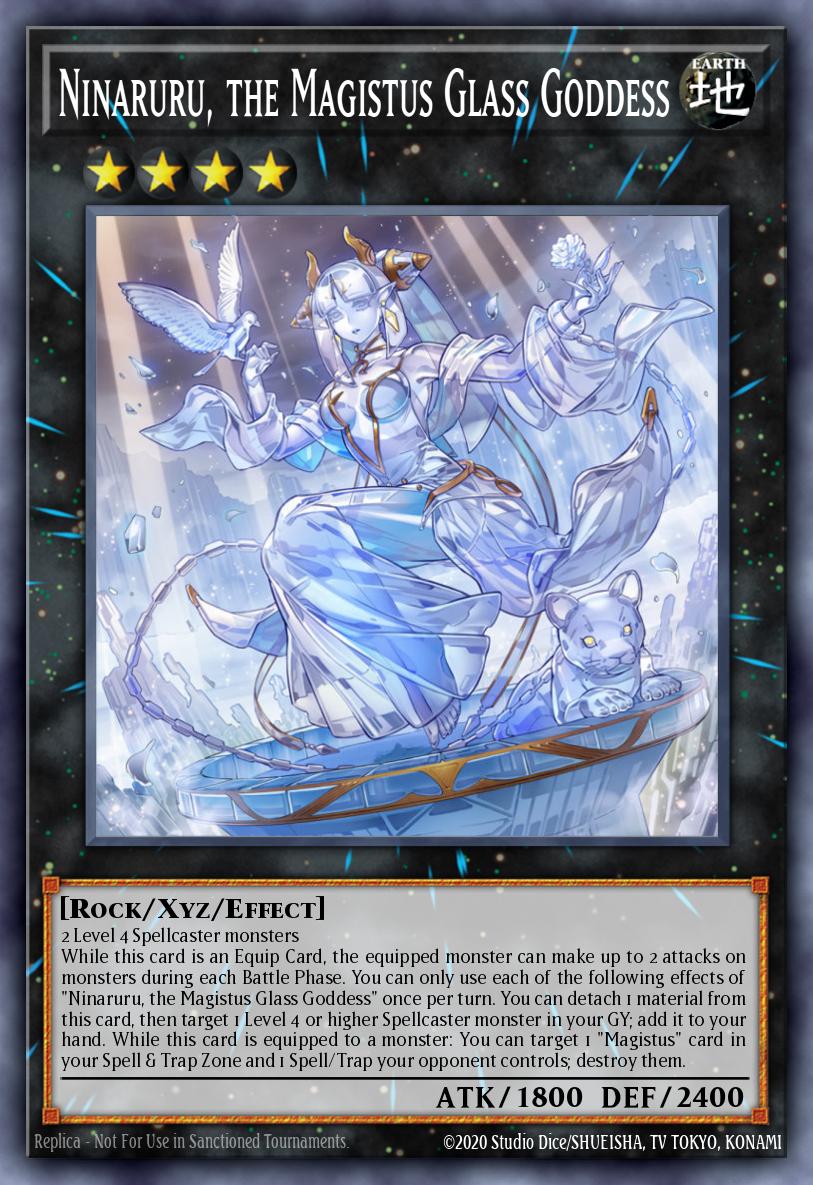
Ninaruru, the Magistus Glass Goddess
Archetype:
Magistus
ATK:
1800
DEF:
2400
View:
4924
2 Level 4 Spellcaster monsters While this card is an Equip Card, the equipped monster can make up to 2 attacks on monsters during each Battle Phase. You can only use each of the following effects of "Ninaruru, the Magistus Glass Goddess" once per turn. You can detach 1 material from this card, then target 1 Level 4 or higher Spellcaster monster in your GY; add it to your hand. While this card is equipped to a monster: You can target 1 "Magistus" card in your Spell & Trap Zone and 1 Spell/Trap your opponent controls; destroy them.
Ninaruru, the Magistus Glass Goddess — Power Evaluation
Final Score: 68 ± 5 · Confidence: Medium
- Intrinsic: 66 · Deck: 68 · Meta: provisional
- Primary role: Material body · Secondary: Recovery / Recursion
Why it scores here
Ninaruru excels as a persistent utility engine in Level 4 Spellcaster decks, delivering clean card advantage through its detach-to-recycle effect and incremental board impact via extra attacks and spell/trap destruction. Its accessible summoning requirement (two Level 4 Spellcasters) and wide splashability across 44 distinct archetypes—especially Magistus and Fairy Tail homes—confirm strong portability. However, the lack of explosive combo potential, no inherent protection, and dependency on setup to access all effects limit its ceiling; it is a steady value generator rather than a game-winner.
Axis scores
| Axis | Score | Evidence |
|---|---|---|
| Accessibility | 80 | Present in 400 decks across 44 archetypes with natural Level 4 Spellcaster access; 94.8% co-deck with Artemus confirms strong synergy in intended homes (observed). |
| Combo & Conversion | 55 | No combo board data available; text infers incremental value (detach for +1 card, conditional S/T destruction, extra attacks) rather than explosive board setup (inferred from text absence). |
| Resource Economy | 70 | The detach effect delivers clean card advantage (send material, add Spellcaster to hand); spell/trap destruction is efficient removal with no card cost (verified from text). |
| Effect & Interaction | 65 | The while-equipped destruction targets 1 Magistus and 1 opponent's spell/trap, providing solid removal but not negation or hard disruption (verified from text). |
| Material Utility | 60 | Rank 4 EARTH Rock Spellcaster body is usable as material for compatible Xyz, Synchro, or Fusion summons, though the XYZ-locked-to-field nature limits immediate reuse (inferred from card type and mechanics). |
| Resilience & Flexibility | 50 | Survives as a field presence over multiple turns via the equip setup, but lacks inherent protection and is easily removed; no built-in recursion beyond the single detach effect (inferred from text). |
| Deck-Building Efficiency | 75 | Single-copy standard inclusion (397 of 400 decks) with minimal garnet risk in Spellcaster homes; light slot cost and no self-locking restrictions (observed from deck data). |
Calculation
Weight profile: 0.7 Material body + 0.3 Recovery / Recursion. Intrinsic ≈ 66, Deck ≈ 68, Meta = provisional. Modifiers: Archetype consistency bonus (1). Final formula: 0.40*Intrinsic + 0.60*Deck
Strengths
- Clean card advantage through once-per-turn detach recursion.
- Multiple utility effects (extra attacks, S/T destruction, Level 4+ Spellcaster recycling) in a single monster.
- Splashable into any Level 4 Spellcaster deck; widely adopted across 44 distinct archetypes.
- No self-locking restrictions; 1 copy is optimal, minimizing garnet risk.
Weaknesses
- No inherent protection; vulnerable to removal, negation, or disruption.
- Requires two Level 4 Spellcasters to summon; not an always-live starter.
- Combo conversion is incremental rather than explosive; does not generate large boards on its own.
- S/T destruction and extra-attack effects require the card to remain on field and be equipped, adding setup cost.
Counters / choke points
- Monster removal (Raigeki, Dark Hole, Droplet) removes the XYZ.
- Negation of Xyz Summon (Veiler, Imperm, Ash Blossom on activation).
- Hand traps targeting Level 4 Spellcaster setup (Ash Blossom, Effect Veiler).
- Rivalry of Warlords on Spellcaster prevents Xyz Summon.
Best use
Persistent utility engine and field control via equip-based recursion and spell/trap destruction.. Decks: Magistus, Fairy Tail, Endymion, Invoked, Witchcrafter, Performage. Suggested copies: 1.
Evidence & gaps
- Verified: Rank 4 XYZ Spellcaster, EARTH, Rock type (card text).; Summoning cost: 2 Level 4 Spellcasters (card text).; Detach effect: target Level 4+ Spellcaster in GY, add to hand, once per turn (card text).; Equip effect: equipped monster makes up to 2 attacks on monsters per Battle Phase (card text).; Equip effect: destroy 1 Magistus card in S/T Zone and 1 opponent's S/T, once per turn (card text).; Present in 400 matched decks; 379 co-decks with Artemus (94.8%) (deck data).; Appears in 44 distinct archetypes; 15.2% of Magistus (archetype 602) (deck data).
- Observed: 1 copy in 397 of 400 decks; 2 copies in 3 decks (standard single inclusion) (deck data).; Listed in CORE section of Magistus guides; mentioned in Ryzeal Magistus and BLS Magistus (guide data).; 52% in gameplay type 7 (Control), 40.5% in type 6 (Beatdown), suggesting meta-wide adoption (deck data).
- Inferred: Combo conversion is incremental: detach yields +1 card, extra attacks scale with equipped monster, S/T destruction is conditional removal; no text describes explosive board generation.; Accessibility is high: Level 4 Spellcasters are foundational in Magistus, Fairy Tail, and Invoked; multiple summoning routes exist within these archetypes.; Material utility is moderate: Level 4 Spellcaster body is compatible with many engines, but Xyz-locked-to-field status limits reuse after summoning.; Resilience is moderate: multi-turn value via equip setup, but no protection and easily removed.
- Data gaps: No combos supplied — combo conversion is inferred from card text only; explosive board potential cannot be verified. No banlist token — assumed 3 copies legal (consistent with deck data showing max 2 copies in sample). No top-card rankings — unable to confirm meta-format performance or viability at high levels of play. Guides are sparse (3 total) — detailed use cases and matchup synergies are not comprehensively documented.