






 Trap
 Normal
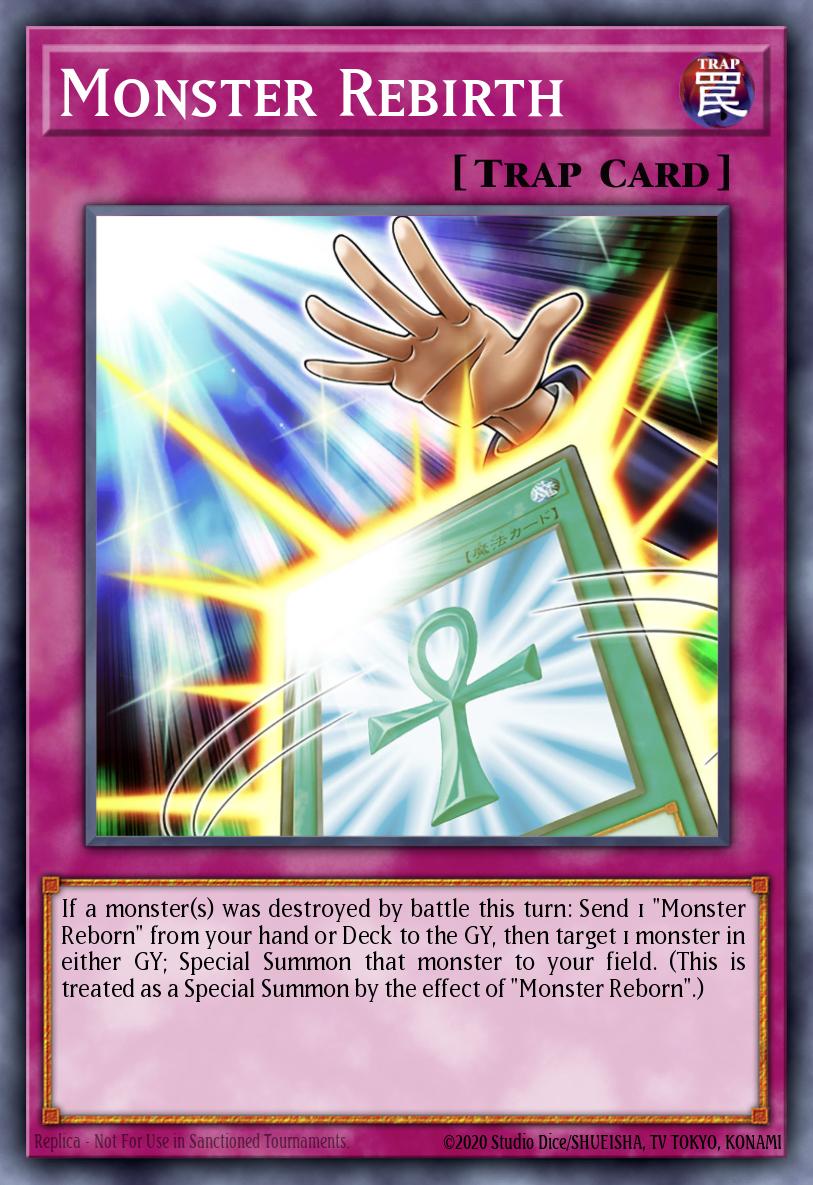
Monster Rebirth
View:
3158
If a monster(s) was destroyed by battle this turn: Send 1 "Monster Reborn" from your hand or Deck to the GY, then target 1 monster in either GY; Special Summon that monster to your field. (This is treated as a Special Summon by the effect of "Monster Reborn".)
Monster Rebirth — Power Evaluation
Final Score: 47 ± 8 · Confidence: Medium
- Intrinsic: 47 · Deck: 47 · Meta: provisional
- Primary role: Recovery/Recursion · Secondary: Starter
Why it scores here
Monster Rebirth converts a battle-destruction event into a revival of a monster from either graveyard, paying for it by sending Monster Reborn from hand or Deck to the GY. Its power is conditional: it needs a monster destroyed by battle this turn, and it is always paired with Monster Reborn (100% of the 20 sampled decks), so it is a recursion tool rather than a self-starting engine. High view count, the 8 archetypes it appears in, and the Top-Card context did not earn points by themselves; they only confirm it is played in practice.
Axis scores
| Axis | Score | Evidence |
|---|---|---|
| Accessibility | 55 | Needs a battle-destruction trigger plus Monster Reborn in hand or Deck, and Monster Reborn co-occurs in 20 of 20 decks; no starter/searched data is supplied (observed for the pairing, inferred for the trigger). |
| Combo & Conversion | 40 | Text revives one monster from either GY and no combo boards are recorded, so conversion beyond one body is unverified (inferred). |
| Resource Economy | 50 | Costs one Monster Reborn to GY and returns one monster to the field, roughly even on cards with a -1 cost offset by a +1 revive (inferred from text). |
| Effect & Interaction | 5 | No negation, removal, or hand-trap reach; the text is purely recursion (verified). |
| Material Utility | 15 | Not a body and provides no material; it only returns an existing monster (verified from card type). |
| Resilience & Flexibility | 35 | Dead without a battle destruction this turn and exposed to any trap-response on the trigger line (inferred from text). |
| Deck-Building Efficiency | 60 | Runs 1 copy on average across the 20 decks with no garnet or lock, but depends on the Monster Reborn slot (observed from copies and partner data). |
Calculation
Weight profile: 0.7 Recovery/Recursion + 0.3 Starter. Intrinsic ≈ 47, Deck ≈ 47, Meta = provisional. Modifiers: none. Final formula: 0.40*Intrinsic + 0.60*Deck
Strengths
- Revives any monster from either graveyard for a single card
- Appears in all 20 sampled decks, always alongside Monster Reborn
- Spread across 8 archetypes, so it is portable across homes
Weaknesses
- Requires a monster destroyed by battle this turn
- No opponent interaction, and no body of its own
- Depends on a second card (Monster Reborn) that must be in hand or Deck
Counters / choke points
- Any effect that stops the battle-destruction trigger, or that negates the trap's activation (general category, not from evidence)
Best use
Recovery/Recursion, paired with Monster Reborn to turn a battle loss into a revived monster. Decks: Black Luster Soldier, Gaia The Fierce Knight, Hole, Lightsworn, Fairy Tail. Suggested copies: 1.
Evidence & gaps
- Verified: Card text: revives one monster from either GY after a battle destruction this turn, costing Monster Reborn to the GY; Card is a Trap card with no ATK/DEF or material value; Monster Reborn co-occurs in 20 of 20 sampled decks
- Observed: Runs 1.3 copies on average, max 3, across 20 decks; Spread across 8 distinct archetypes in the deck sample
- Inferred: Trigger requires a battle destruction this turn, which limits its use to combat turns; Revive is roughly resource-neutral on paper but card-disadvantageous in practice when Monster Reborn is a dead draw; Accessibility is moderate because it needs a battle result and a second card
- Data gaps: no combos supplied, so combo conversion is text-only inference no guides supplied no banlist token, assumed 3 copies (unlimited) no usage statistics (StatisticsCard), so archetype inclusion is inferred from the deck sample only