






 Trap
 Continuous
Mistake
View:
6581
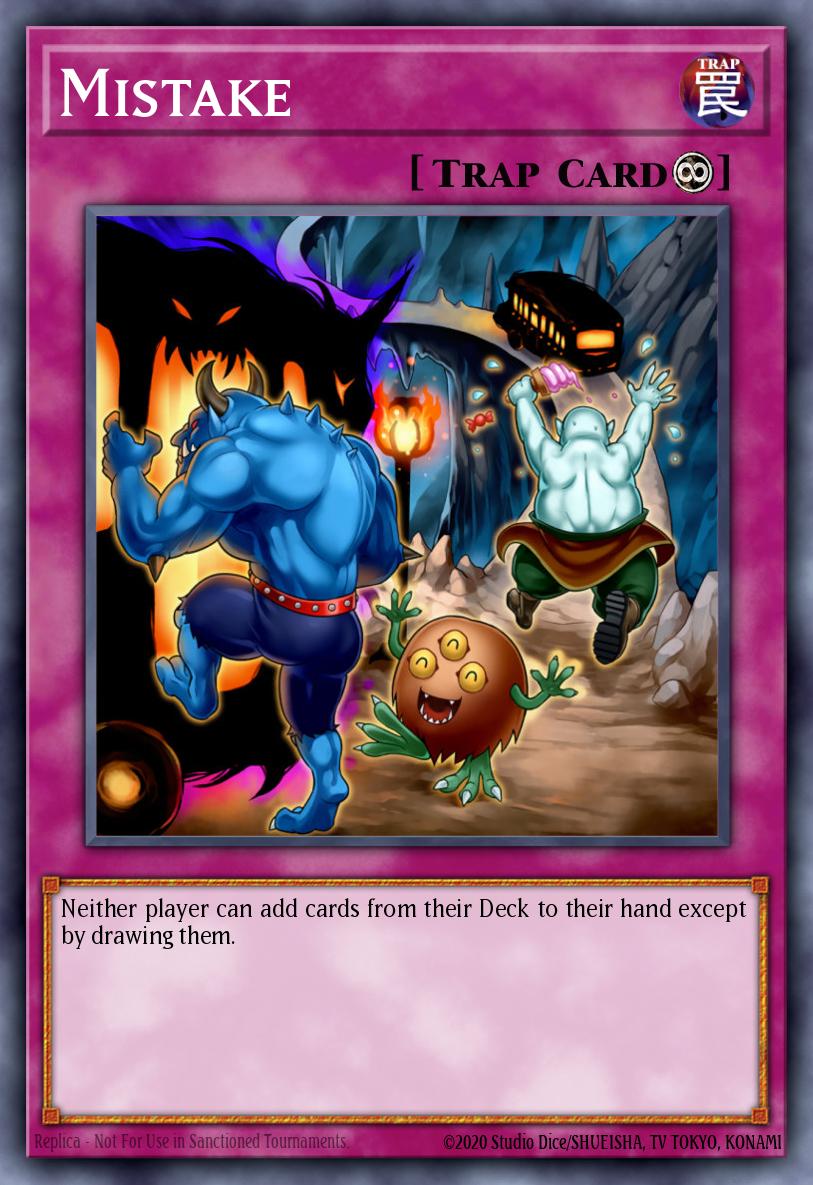
Neither player can add cards from their Deck to their hand except by drawing them.
Mistake — Power Evaluation
Final Score: 71 ± 5 · Confidence: Medium
- Intrinsic: 69 · Deck: 70 · Meta: provisional
- Primary role: Floodgate/Control
Why it scores here
Mistake is a universal floodgate that shuts off deck searching—a core modern mechanic—making it a reliable going-first tech across 72 distinct archetypes. Its strength is persistent, passive disruption: one resolution forces both players to rely on draws rather than tutoring, which significantly slows combo decks dependent on consistent searches. The card's minimal deckbuilding cost (clean trap slot, 1.88 avg copies) and splashability drive its inclusion signal. However, the score is capped by vulnerability to abundant trap removal (Harpie's and Evenly Matched in ~30–45% of decks), lack of card advantage generation, and zero material utility—it is purely disruptive, not a value engine.
Axis scores
| Axis | Score | Evidence |
|---|---|---|
| Accessibility | 72 | Settable from hand with no tutoring requirement; 400 decks across 72 archetypes confirm practical inclusion, though it requires field survival to activate continuously (observed) |
| Combo & Conversion | 15 | Mistake does not build boards or enable combos; it is a passive floodgate with zero combo potential, appearing in 0 recorded combo boards (verified) |
| Resource Economy | 50 | The card is 1-for-0 initially but provides soft advantage by denying opponent searches; net card count is even but disruptive in value (inferred) |
| Effect & Interaction | 78 | Blocks all deck-search tutoring, a critical modern mechanic affecting most combo decks; non-targeted and persistent, but allows normal draws and grind plays (verified from text, observed from partner cards) |
| Material Utility | 5 | Continuous Trap cards cannot be used as Synchro/Fusion/Link/Xyz material and have no material cost effects; intrinsically zero utility as material (verified) |
| Resilience & Flexibility | 62 | Survives as a continuous trap once Set, but is vulnerable to trap removal present in 29–45% of decks; no recovery or recursion (observed from top partners, inferred from trap mechanics) |
| Deck-Building Efficiency | 85 | Fits cleanly into any deck with spare trap slots, is not archetype-locked, and runs 1.88 avg copies without conflict; nearly free-roll inclusion (verified) |
Calculation
Weight profile: Primary role: Floodgate/Control. Intrinsic ≈ 69, Deck ≈ 70, Meta = provisional. Modifiers: Exceptional splashability (2); Non-scaling disruption (-1). Final formula: 0.40*Intrinsic + 0.60*Deck
Strengths
- Blocks all deck searching, shutting down core combo tutoring lines in modern meta
- Persistent continuous effect; one resolution, many turns of value if it survives removal
- Universal against all decks; symmetric effect makes it hard to exploit
- Clean tech insertion; no deckbuilding friction, splashable across 72+ archetypes
- Minimal cost to run 2–3 copies; avg 1.88 copies per deck confirms acceptability
Weaknesses
- Requires field survival; vulnerable to spell/trap removal (Harpie's 29%, Evenly Matched 45.5% of decks)
- Provides no card advantage; only soft advantage through opponent disruption
- Cannot serve as material or combo piece; purely passive effect
- Affects both players equally; may slow your own grind or recovery lines if needed
- No recursion or recovery from graveyard; one removal ends the lock
Counters / choke points
- Harpie's Feather Duster (29% of decks)
- Evenly Matched (45.5% of decks)
- Mystical Space Typhoon/Twin Twisters (common trap removal alternatives)
- Field-clearing trap removals (Lightning Storm, etc.)
- Graveyard effects bypassing search (recursion, GY-to-hand cards)
Best use
Going-first floodgate to lock opponent search tutoring. Decks: Eldlich (20.8%), Blue-Eyes (5.8%), White Forest (5%), Magistus (5%), Diabellstar (5%), Azamina (5%), Labrynth (3.5%), True Draco (3.2%), Generic going-first trap decks.
Evidence & gaps
- Verified: Mistake prevents all deck searching except drawing for both players (card text); Present in 400 decks across TCG/OCG/MasterDuel formats (deck sample); Continuous Trap card type; does not generate card advantage directly (card type); Average 1.88 copies per deck; distributed as 1 copy (140 decks), 2 copies (168 decks), 3 copies (92 decks)
- Observed: Appears in 72 distinct archetypes, with Eldlich primary (20.8%); secondary homes Blue-Eyes (5.8%), White Forest (5%), Magistus (5%), Diabellstar (5%), Azamina (5%); Co-appears with Maxx 'C' in 60.2% of decks; Infinite Impermanence 51.2%; Ash Blossom 49.2% (suggests search-denial-heavy meta); Trap removal prevalent in top partners: Harpie's (29%), Evenly Matched (45.5%); indicates meta vulnerability; Mentioned in 1 guide (Eldlich) as trap/floodgate tech for control-focused builds
- Inferred: Mistake provides soft hand advantage by denying opponent search tutoring, core modern Yu-Gi-Oh mechanic (from text + metagame logic); Non-targeted, universal, both-players-affected symmetrical floodgate with high disruption ceiling (from mechanics); Lack of combo appearances (0 combos) confirms non-combo-enabler, validating floodgate role over enabler; 72 archetypes running it indicates generically applicable going-first tech, not synergy-specific inclusion (from deck evidence)
- Data gaps: No combos supplied—combo conversion and combo-line participation are text-only inference; card consistent with non-combo floodgate role No banlist token—assumed 3 copies unlimited in all formats No usage statistics (StatisticsCard)—archetype inclusion % and typical copies inferred from deck sample only; no historical trend data No Top Card ranking—card not flagged as top-performing staple in format rankings, limiting metagame confirmation