






 Trap
 Normal
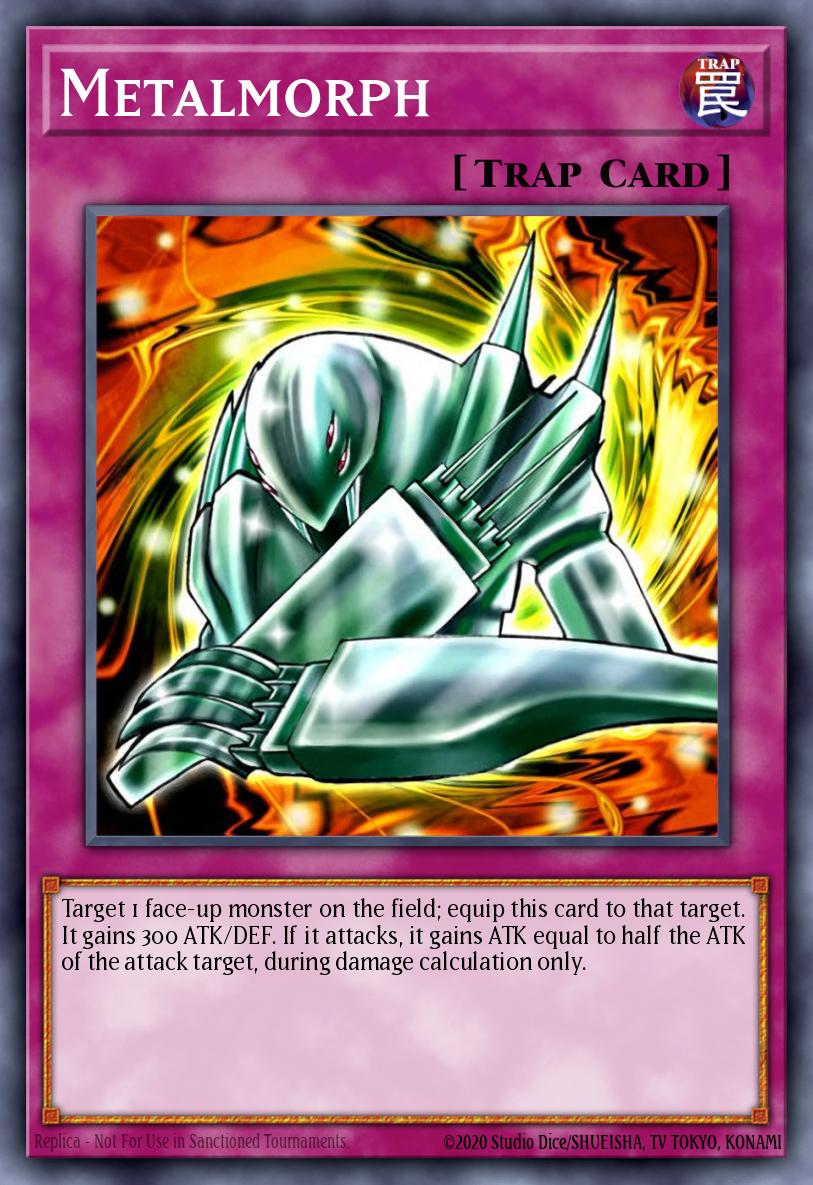
Metalmorph
View:
9682
Target 1 face-up monster on the field; equip this card to that target. It gains 300 ATK/DEF. If it attacks, it gains ATK equal to half the ATK of the attack target, during damage calculation only.
Metalmorph — Power Evaluation
Final Score: 48 ± 5 · Confidence: Medium
- Intrinsic: 47 · Deck: 49 · Meta: provisional
- Primary role: Utility
Why it scores here
Metalmorph is a broad-spectrum utility equip that appears in 167 decks across 49 archetypes, primarily as a Labrynth tech (24.6%), confirming solid accessibility and splashability. However, it generates no card advantage, has no opponent interaction, and cannot initiate combos—it only boosts an existing monster's attack value during battle, a secondary concern in modern Yu-Gi-Oh! where board control and disruption dominate. The card's modest static ATK bonus and lack of synergistic effects limit its power to a support role.
Axis scores
| Axis | Score | Evidence |
|---|---|---|
| Accessibility | 60 | Metalmorph appears in 167 decks across 49 distinct archetypes with no deck restrictions, demonstrating broad adaptability; however, it requires a live monster on field to activate (verified from card text). |
| Combo & Conversion | 25 | No combo data supplied; as an equip with no generative effects, Metalmorph does not enable multi-card synergies or combo chains (inferred from card text). |
| Resource Economy | 40 | Metalmorph has a net cost of one card with no card draw, search, or GY-refuel effect; if the equipped monster is removed, the equip is lost (verified from card text and equip mechanics). |
| Effect & Interaction | 10 | Metalmorph provides no negation, destruction, removal, or hand-trap effects; it only boosts attack with no opponent-facing disruption (verified from card text). |
| Material Utility | 15 | As a Normal Trap with no Tuner/attribute/level status, Metalmorph has minimal utility as Synchro/Fusion/Link material in most strategies (verified from card type). |
| Resilience & Flexibility | 35 | As an equip trap, Metalmorph is lost if the equipped monster is removed or negated, and cannot be reused across turns without being set again, providing limited multi-zone resilience (verified from equip and trap mechanics). |
| Deck-Building Efficiency | 70 | Metalmorph runs at 1–2 copies in 167 decks (avg 1.27) with minimal garnet potential and no archetype-specific build-around requirements, indicating strong splashability (verified from deck distribution). |
Calculation
Weight profile: Primary role: Utility / no clear role (default). Intrinsic ≈ 47, Deck ≈ 49, Meta = provisional. Modifiers: none. Final formula: 0.40*Intrinsic + 0.60*Deck
Strengths
- Broadly splashable across 49 distinct archetypes with no deckbuilding restrictions
- Low garnet potential and minimal resource cost (runs at 1–2 copies)
- Clear, unambiguous card text with no complex timing or ruling issues
- Permanent ATK/DEF boost makes equipped monster more threatening in battle
Weaknesses
- Generates no card advantage or resource refuel
- Has no opponent interaction, negation, or disruption effects
- Cannot initiate combos or generate multi-card synergies
- Vulnerable to removal: lost if equipped monster is destroyed or negated
- Battle-focused effect is secondary priority in modern competitive Yu-Gi-Oh!
Counters / choke points
- Red Reboot (negates trap activation)
- Seven Tools of the Bandit (negates trap activation)
- Monster removal or bounce effects (loss of equipped monster means loss of equip)
Best use
Utility equip tech for boosting existing monsters in battle. Decks: Labrynth, Red-Eyes, Dark Magician, Dragon Link.
Evidence & gaps
- Verified: Card text confirmed: equip trap granting +300 ATK/DEF plus conditional ATK during damage calc; Appears in 167 decks across 49 archetypes (deck statistics verified); No banlist restrictions (assumed from no banlist token; unlimited copies); Normal Trap card type with no inherent material synergies or combo enablement; Equip mechanic: lost if equipped monster is removed or negated
- Observed: Labrynth is primary archetype (24.6% of decks, 41 appearances); Red-Eyes secondary archetype (9% of decks, 15 appearances); Broad adoption across 49 distinct archetypes confirms generic utility; Average 1.27 copies per deck; 136 decks run 1 copy, 17 run 2, 14 run 3; Primarily main-deck (167 main / 0 side-deck appearances)
- Inferred: Combo conversion is low: no combo data supplied, and equips are generally not combo pieces; Material utility is low: trap cards lack inherent Level/Attribute/Tuner value; Resilience is moderate-low: loss of equipped monster equals loss of equip; Generic utility is high: no archetype-specific requirements or deck lock mechanics
- Data gaps: No combos supplied — combo conversion is text-only inference No guides supplied — no human context on card role or usage priority No banlist token — assumed 3 copies (unlimited) No usage statistics (StatisticsCard) — archetype inclusion % inferred from deck sample only No top-card ranking data — cannot confirm meta relevance or tier placement