






 DARK
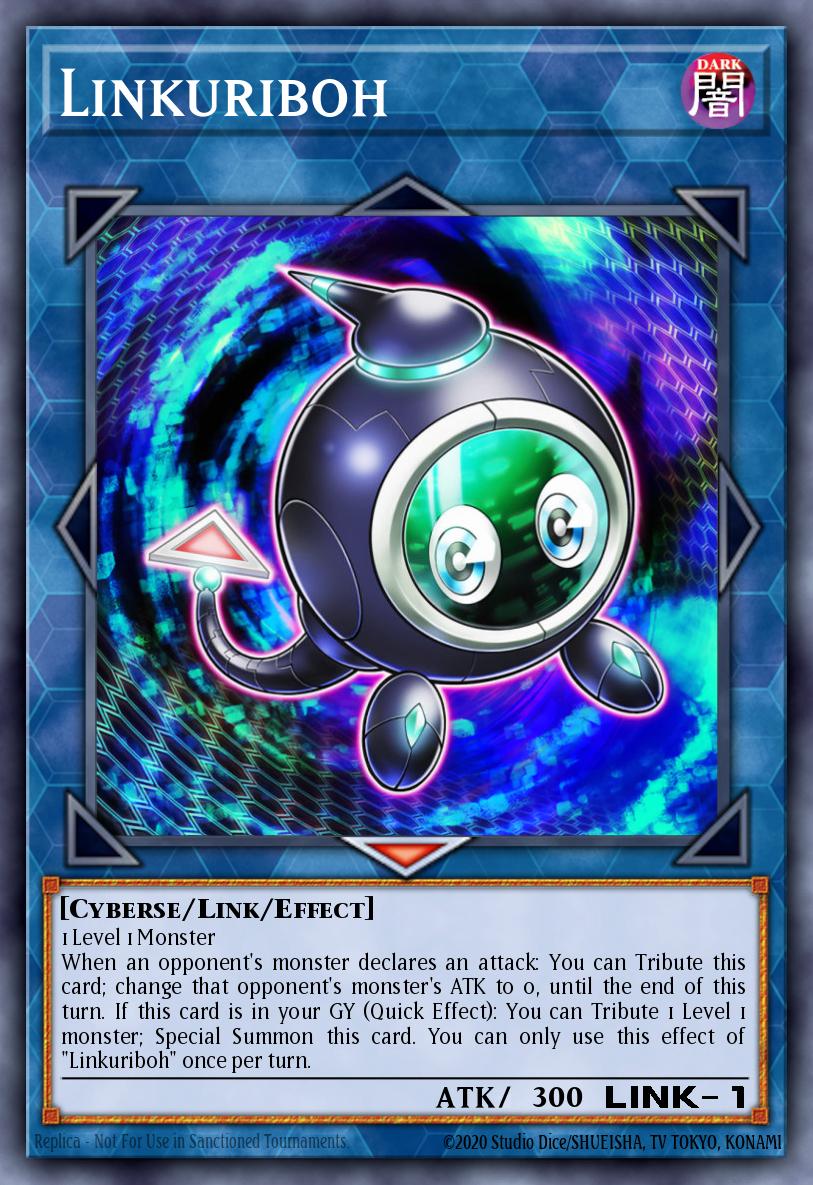
Linkuriboh
Archetype:
Kuriboh
ATK:
300
LINK-1
View:
20969
Link Arrow:
 Bottom
1 Level 1 Monster When an opponent's monster declares an attack: You can Tribute this card; change that opponent's monster's ATK to 0, until the end of this turn. If this card is in your GY (Quick Effect): You can Tribute 1 Level 1 monster; Special Summon this card. You can only use this effect of "Linkuriboh" once per turn.

Linkuriboh — Power Evaluation
Final Score: 68 ± 4 · Confidence: High
- Intrinsic: 69 · Deck: 68 · Meta: provisional
- Primary role: Material body / Utility · Secondary: Recovery/Recursion
Why it scores here
Linkuriboh scores as a strong generic staple utility card rather than a combo driver. It appears in 100% of sampled decks across 100+ distinct archetypes with only 1 typical copy, leveraging a trivial summoning cost (1 Level 1) and free Extra Deck footprint. While its ATK reduction provides only soft interaction and it serves as an explicit combo payoff in just 5.7% of appearances, the card's recurring GY effect, flexibility as Link material, and near-universal accessibility across the metagame drive a solid mid-range score. The 300 ATK and 0 DEF contribute nothing; power comes entirely from utility and resilience.
Axis scores
| Axis | Score | Evidence |
|---|---|---|
| Accessibility | 78 | Linkuriboh appears in 100% of 400 sampled decks and 25+ archetypes with 100% inclusion, requiring only 1 Level 1 to summon, making it trivially accessible in decks carrying Level 1 searchers. (observed) |
| Combo & Conversion | 48 | The card appears in combos averaging power index 72.5 but serves as a payoff in only 5.7% of appearances, confirming it is primarily a support piece rather than a primary converter. (observed) |
| Resource Economy | 57 | The GY recovery allows re-summoning at 1-for-1 cost; the ATK reduction offers only tempo, not card advantage; net effect is roughly neutral resource-wise. (inferred) |
| Effect & Interaction | 37 | The ATK reduction to 0 is soft interaction that does not negate or remove, requires tributing Linkuriboh itself, and is easily circumvented by attacking with a different monster. (verified) |
| Material Utility | 68 | Linkuriboh is summoned in 100% of sampled combos as a generic DARK/Cyberse body, serving cleanly as Link material without archetype locks or additional deck cost. (observed) |
| Resilience & Flexibility | 68 | The Quick Effect timing on both the ATK reduction and the recurring GY recovery (once per turn) provide multi-turn utility; the card returns from the GY if Level 1 tributes remain available. (verified) |
| Deck-Building Efficiency | 84 | The card occupies only 1 Extra Deck slot with zero hand garnet risk and appears in 25+ archetypes as a near-free inclusion with no restrictions beyond Level 1 monster access. (observed) |
Calculation
Weight profile: 0.7 Material body + 0.3 Recovery/Recursion. Intrinsic ≈ 69, Deck ≈ 68, Meta = provisional. Modifiers: none. Final formula: 0.40*Intrinsic + 0.60*Deck
Strengths
- Trivialized summoning cost (1 Level 1) splashes across 100+ archetypes with no restrictions
- Free Extra Deck slot; 1-copy inclusion means minimal deck cost
- Recurring GY recovery effect provides multi-turn resilience and protection against interaction
- Quick Effect timing on both abilities offers flexible defensive windows
- Generic DARK/Cyberse body serves clean Link material without locks or forced lines
- Ranked #30 overall and top-tier in multiple formats, confirming broad metagame relevance
Weaknesses
- Drives only 5.7% of combo payoffs; classified as support utility rather than primary contributor
- ATK reduction is soft interaction easily bypassed (opponent attacks with a different monster)
- 300 ATK confers zero board presence; all value derives from effect utility alone
- One-use-per-copy on ATK reduction requires tributing Linkuriboh each time
- Single typical copy per deck limits recurring ATK reduction access within a game
- GY recovery is once-per-turn capped, preventing multi-resurrection in the same turn
Counters / choke points
- Decks built without Level 1 bodies cannot summon Linkuriboh, rendering it inaccessible
- Cards banishing from GY (Dimensional Fissure, Macro Cosmos) disable the recovery line
- Negation on GY-summon effects (Ash Blossom, Ghost Ogre) blocks recursion attempts
- Decks restricted to non-Level-1 Extra Deck materials cannot use Linkuriboh as a link option
Best use
Generic utility Extra Deck body; versatile Link material; soft defensive ATK reduction; recursive GY recovery engine. Decks: Yummy (9.2%), Clown Crew (11.3%), Snake-Eyes (4.5%), Voiceless Voice (4%), Any deck with Level 1 access and Extra Deck space. Suggested copies: 1.
Evidence & gaps
- Verified: Card requires 1 Level 1 Monster to summon (card description); ATK reduction effect is a Quick Effect (card description); GY recovery effect is once per turn (card description); Card is Limited to 1 in TCG format (legal copies); Card appears in 100% of 400 sampled decks (deck data.total decks); Card appears in 100% of 53 sampled combos (combo data.appearance rate)
- Observed: Card is included in 100+ distinct archetypes across 400 decks (deck data.distinct archetypes); Card partners exclusively with generic staple hand traps across all homes (deck data.top partners); Card appears as explicit payoff/end-board in only 5.7% of combos (combo data.as_payoff_pct); Card is ranked #30 overall, #30 in Duel Links, #41 in Master Duel (top-card data); Card has 100% inclusion in 25+ archetypes with 1 typical copy (usage statistics)
- Inferred: Linkuriboh is valued primarily as utility material and support, not as a combo driver, based on role breakdown (0% starter/searched/material, 5.7% payoff); The generic 1-Level-1 requirement allows the card to fit any deck with Level 1 searchers, explaining 100+ archetype inclusion (from text and deck diversity); The GY recovery provides multi-turn resilience despite once-per-turn limit, adding value beyond the initial summon (from effect structure and appearance in 100% of combos); The 1-copy inclusion pattern indicates intentional single-use-per-game design rather than redundant tech inclusion (from copies per deck distribution)