





 DARK
 4
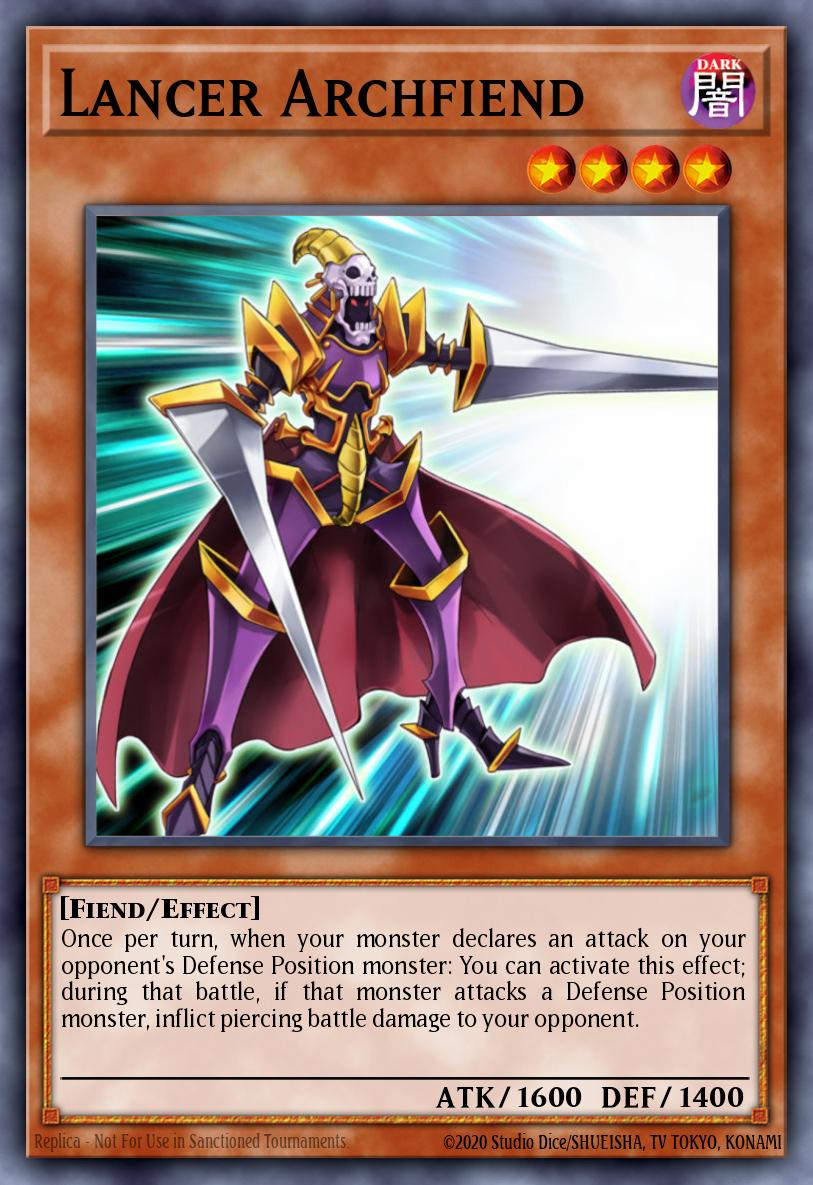
Lancer Archfiend
Archetype:
Archfiend
ATK:
1600
DEF:
1400
View:
3563
Once per turn, when your monster declares an attack on your opponent's Defense Position monster: You can activate this effect; during that battle, if that monster attacks a Defense Position monster, inflict piercing battle damage to your opponent.
Lancer Archfiend — Power Evaluation
Final Score: 53 ± 8 · Confidence: Medium
- Intrinsic: 55 · Deck: 51 · Meta: provisional
- Primary role: Material body / Normal
Why it scores here
Lancer Archfiend is a generic Level 4 DARK Fiend body. Its only effect is a once-per-turn piercing-damage clause on attacks into Defense Position monsters, which is a minor offensive rider with no card advantage, search, or interaction. Its score comes from being a clean Level 4 material that stays useful even when its effect is negated, and from being cheap to run with unlimited copies. Its 1600 ATK earns nothing on its own, and the 35-deck spread confirms it is a reliable body rather than a strong card.
Axis scores
| Axis | Score | Evidence |
|---|---|---|
| Accessibility | 55 | Live as a Level 4 body in 35 of 35 sampled decks, typically 1 to 3 copies, but it has no search or draw route in its text (observed, deck counts; inferred, no searcher). |
| Combo & Conversion | 25 | No recorded boards (combo data total 0) and the effect only adds piercing damage, so it converts little on its own (inferred from text). |
| Resource Economy | 15 | No card advantage, search, or recursion in the text, so it is roughly a single body (verified from card text). |
| Effect & Interaction | 8 | The effect is offensive only, with no negation, removal, or disruption (verified from card text). |
| Material Utility | 65 | Level 4 DARK Fiend with no Tuner status, a generic material fit that still converts when its effect is negated (inferred from stats and text, observed across 15 archetypes). |
| Resilience & Flexibility | 40 | Used across 15 archetypes, so it is not tied to one home, but its body is easy to remove and it has no redundancy effect (observed, deck spread; inferred, no protection). |
| Deck-Building Efficiency | 85 | Legal in all four formats with no garnet or lock restriction, and copies are unlimited, so it is a near free-roll slot (verified, formats and data gaps). |
Calculation
Weight profile: Material body / Normal primary; no secondary role blend. Intrinsic ≈ 55, Deck ≈ 51, Meta = provisional. Modifiers: none. Final formula: 0.40*Intrinsic + 0.60*Deck
Strengths
- Clean Level 4 DARK Fiend material that stays usable when its effect is negated
- Unlimited copies and legal in all four formats, so it costs almost nothing to run
- Spread across 15 archetypes, so it has many homes
Weaknesses
- No search, draw, or recursion, so it does not generate advantage
- The effect is a minor piercing rider with little impact on the board
- No combo evidence, so its conversion value rests on text alone
Counters / choke points
- Standard hand traps and monster removal can strip the body with no real cost to the opponent
- Level 4 material is abundant, so the card is easy to replace
Best use
Level 4 Fiend material body in decks that need a generic Level 4 for Xyz or Synchro lines. Decks: Archfiend, Wicked God, Branded, Borrel. Suggested copies: 2.
Evidence & gaps
- Verified: Effect is a once-per-turn piercing-damage rider on attacks into Defense Position monsters, with no other effects; Level 4 DARK Fiend, 1600 ATK, 1400 DEF, legal in TCG, OCG, MasterDuel, and DuelLinks; Unlimited copies per the banlist gap assumption
- Observed: Appears in 35 of 35 sampled decks, with 1.54 average copies and 15 distinct archetypes; Partners include Allure of Darkness at 74 percent of decks, a deck-frequency figure only
- Inferred: Functions as a generic Level 4 material body even when the effect is negated; Offers minor offensive value and no interaction or card advantage; Deck synergy and resilience are moderate because combo evidence is absent
- Data gaps: no combos supplied, so combo conversion is text-only inference no guides supplied no banlist token, so unlimited copies are assumed no usage statistics (StatisticsCard), so archetype inclusion is inferred from the deck sample only