






 Trap
 Normal
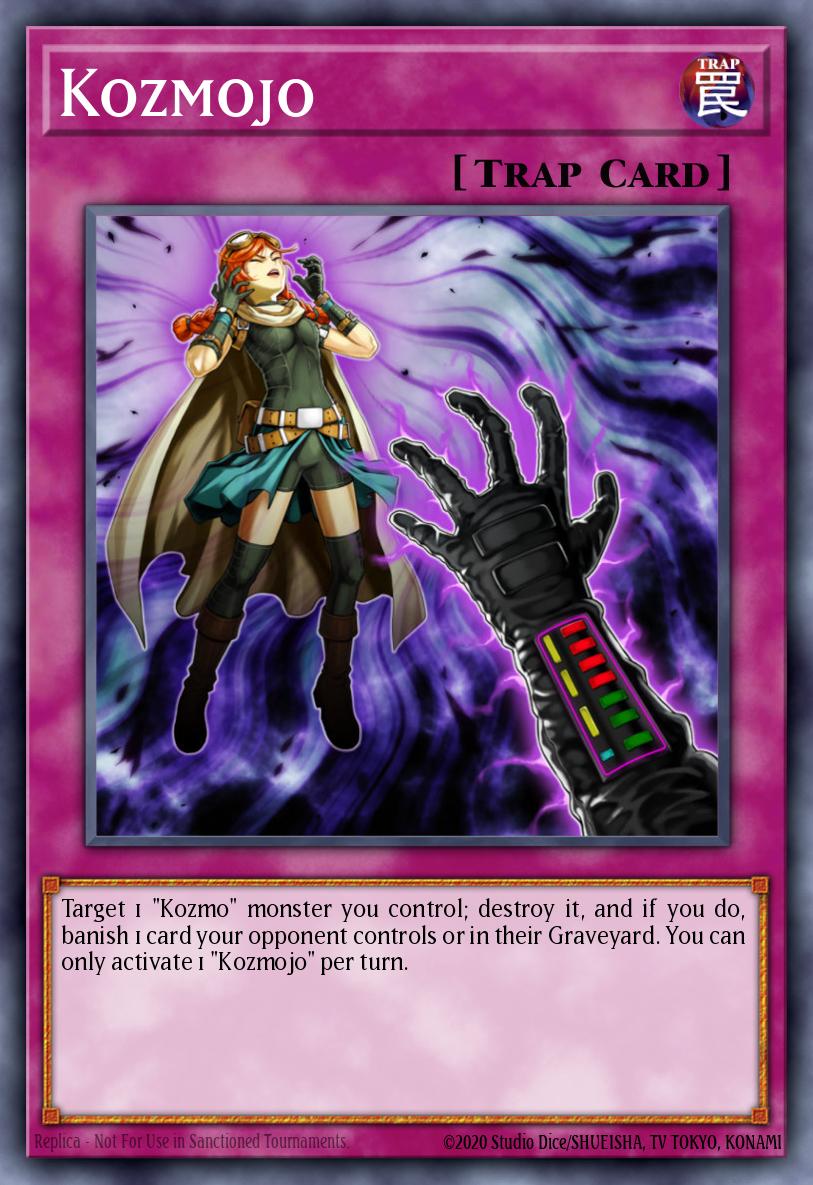
Kozmojo
Archetype:
Kozmo
View:
3901
Target 1 "Kozmo" monster you control; destroy it, and if you do, banish 1 card your opponent controls or in their Graveyard. You can only activate 1 "Kozmojo" per turn.
Kozmojo — Power Evaluation
Final Score: 56 ± 6 · Confidence: Medium
- Intrinsic: 55 · Deck: 57 · Meta: provisional
- Primary role: Removal / Negation · Secondary: Negation/Interaction
Why it scores here
Kozmojo converts one of your own Kozmo monsters into a one-for-one answer to any opponent card on the field or in the Graveyard, limited to once per turn. Its score is held down by the Kozmo-only trigger, the absence of any combo data, and its exposure as a set trap that can be negated or destroyed in the backrow (inference from general rules, not card text). Its presence in all 241 sampled decks reflects consistent play inside the Kozmo theme rather than intrinsic power, so that inclusion earned no points on its own.
Axis scores
| Axis | Score | Evidence |
|---|---|---|
| Accessibility | 65 | Set trap that needs a Kozmo monster you control as its target, and the sample shows it running main in 241 of 241 decks (observed; the Kozmo monster requirement is verified from text). |
| Combo & Conversion | 40 | No recorded combo boards (total_combos 0), so conversion rests on text alone: one removal for the cost of one own monster (inferred). |
| Resource Economy | 45 | Destroys one of your monsters and banishes one opposing card, which nets roughly even at best and gives no refuel or draw (verified from text, inferred balance). |
| Effect & Interaction | 58 | Flexible target across the field and Graveyard, banishing rather than destroying the opponent card, but it is once per turn and conditional on the self-destruction (verified from text). |
| Material Utility | 0 | A trap has no body, so it cannot be used as Xyz, Link, Synchro or Fusion material (verified from card type). |
| Resilience & Flexibility | 45 | Set-trap timing gives some protection from sorcery-speed interaction, but it can be negated or removed from the backrow and has no redundancy beyond copies (inferred from general rules; copies observed at avg 1.73). |
| Deck-Building Efficiency | 70 | Runs at 1 to 3 copies (avg 1.73), with no garnet or lock restriction and a clean slot cost inside the Kozmo shell (observed). |
Calculation
Weight profile: Removal / Negation profile; no secondary blend applied because the card has a single clear primary role. Intrinsic ≈ 55, Deck ≈ 57, Meta = provisional. Modifiers: none. Final formula: 0.40*Intrinsic + 0.60*Deck
Strengths
- Flexible once-per-turn answer to any opponent card, including Graveyard cards
- Live in 241 of 241 sampled decks, so access is consistent
- Clean deckbuilding cost at 1 to 3 copies
Weaknesses
- Requires a Kozmo monster on the field, so it is dead without a Kozmo body
- Card-neutral at best because it destroys one of your own monsters
- No combo evidence, so its conversion value is text-only
Counters / choke points
- Backrow removal or trap negation, which would strip the set trap before it resolves (inferred from general rules)
- Opponent boards with no targetable Kozmo monster to start the activation
Best use
Removal / Negation. Decks: Kozmo. Suggested copies: 2.
Evidence & gaps
- Verified: Card text: target 1 Kozmo monster you control, destroy it, and if you do, banish 1 card your opponent controls or in their Graveyard; once per turn; Main-deck inclusion in 241 of 241 decks, average 1.73 copies; Top partners include Kozmo Sliprider at 97.5 percent co-occurrence
- Observed: Copy distribution: 112 decks at 1, 81 at 2, 48 at 3; Three Kozmo archetype ids account for most decks
- Inferred: Card-neutral trade because it destroys one of your own monsters; Vulnerable to backrow removal and negation, based on general trap rules; Set-trap timing is the primary reason for its access
- Data gaps: no combos supplied, so combo conversion is text-only inference no banlist token, so unlimited copies were assumed no usage statistics (StatisticsCard), so archetype inclusion is inferred from the deck sample only deck_synergy is inferred from partner co-occurrence, not from combo centrality