





 DARK
 1
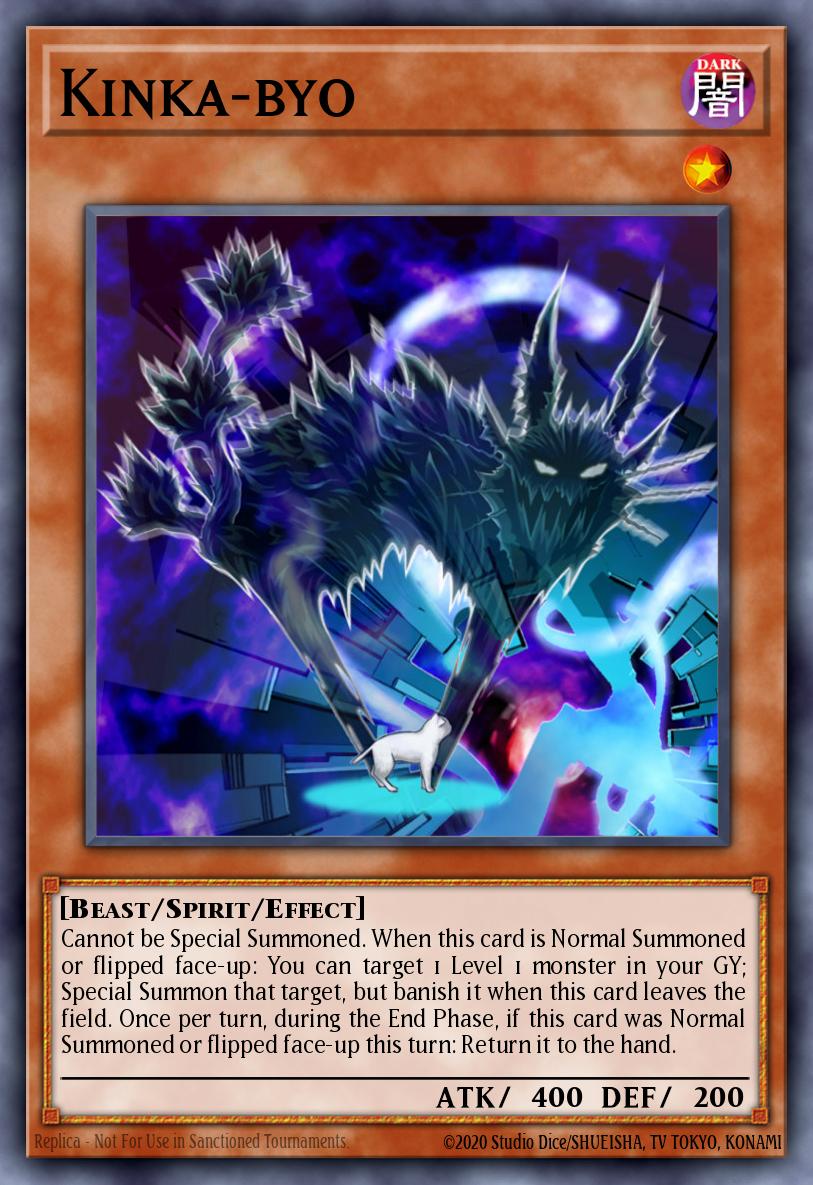
Kinka-byo
ATK:
400
DEF:
200
View:
4619
Cannot be Special Summoned. When this card is Normal Summoned or flipped face-up: You can target 1 Level 1 monster in your GY; Special Summon that target, but banish it when this card leaves the field. Once per turn, during the End Phase, if this card was Normal Summoned or flipped face-up this turn: Return it to the hand.
Kinka-byo — Power Evaluation
Final Score: 60 ± 8 · Confidence: Medium
- Intrinsic: 59 · Deck: 60 · Meta: provisional
- Primary role: Extender · Secondary: Material body
Why it scores here
Kinka-byo's reliable output is one Normal Summon that puts a Level 1 monster from the GY onto the field, plus a once-per-turn bounce to hand that lets it be Normal Summoned again. The Special Summoned GY monster is banished when Kinka-byo leaves the field, so the card spends GY resources rather than generating card advantage. Its 400 ATK/200 DEF earns nothing, and its presence in 400 of 400 sampled decks mostly reflects Lyrilusc (about 58% of decks), which confirms accessibility rather than intrinsic power. The single recorded board is too thin to raise synergy or conversion meaningfully.
Axis scores
| Axis | Score | Evidence |
|---|---|---|
| Accessibility | 75 | Normal Summonable from hand with no searcher needed and present in all 400 sampled decks at about 1.9 copies each, though this reflects Lyrilusc popularity more than the card's own strength (verified deck stats; inference on hand access from text). |
| Combo & Conversion | 55 | Its one recorded board shows it as starter and material with a power index of 100, but n=1 and the effect only yields one GY-based body per Normal Summon (observed, low sample). |
| Resource Economy | 45 | The GY target is banished when Kinka-byo leaves, and the bounce only refunds the Normal Summon slot, so there is no net card advantage in the card text (verified from text; the single board's netCardAdvantage of 3 is not representative). |
| Effect & Interaction | 5 | No opponent interaction or negation is present in the card text, only a self-contained summon trigger (verified from text). |
| Material Utility | 60 | A clean Level 1 DARK Beast body that can serve as material wherever a Level 1 is needed, and appears as material in its one recorded board (verified from level and text; inferred for generic material fit). |
| Resilience & Flexibility | 45 | The trigger is shut off by a single negation of the Normal Summon or effect, though the end-phase bounce gives some multi-turn reuse (inferred from text). |
| Deck-Building Efficiency | 80 | Plays 1 to 3 copies with no garnets or locks beyond the Normal-Summon-only restriction, so it fits almost any deck slot cheaply (verified deck copies distribution). |
Calculation
Weight profile: 0.7 Extender + 0.3 Material body. Intrinsic ≈ 59, Deck ≈ 60, Meta = provisional. Modifiers: Normal-Summon-only restriction (-2). Final formula: 0.40*Intrinsic + 0.60*Deck (decks and combos present; meta null)
Strengths
- Converts one Normal Summon into a Level 1 GY-to-field body
- Once-per-turn end-phase bounce allows the Normal Summon and trigger to be reused
- Clean Level 1 material body with no garnet cost
- Present in all 400 sampled decks at about 1.9 copies
Weaknesses
- Cannot be Special Summoned and uses the Normal Summon slot
- The GY target is banished when the card leaves the field, so the net card advantage is zero or negative
- One negation of the trigger ends the line
- Combo evidence rests on a single recorded board
Best use
Normal Summon Extender / Level 1 body. Decks: Lyrilusc. Suggested copies: 2.
Evidence & gaps
- Verified: Level 1 DARK Beast Spirit effect monster, 400 ATK / 200 DEF; Cannot be Special Summoned; Normal Summon or flip trigger targets a Level 1 GY monster and banishes it when Kinka-byo leaves the field; Once-per-turn End Phase bounce to hand if Normal Summoned or flipped this turn; Present in 400 of 400 sampled decks; 1.91 average copies; 52 distinct archetypes; Top partners are Lyrilusc monsters at 53 to 69% co-occurrence
- Observed: One recorded combo board with the card as starter and material, power index 100; Lyrilusc archetype IDs account for about 58% of sampled decks
- Inferred: Normal Summonable from hand, so accessibility is high; Generic Level 1 body that fits Level 1 material requirements; Negation of the trigger or the Normal Summon shuts the line down
- Data gaps: Combo evidence is a single board (n=1), so combo_conversion and synergy are low-confidence No banlist token supplied; unlimited copies assumed No usage statistics (StatisticsCard) available; inclusion is inferred from the deck sample only No rulings supplied for the banish-on-leave and End Phase bounce timing No counter or negation evidence supplied Lyrilusc dominance (about 58% of decks) means the deck signal mostly measures one archetype's popularity