






 Trap
 Normal
Graverobber
View:
5190
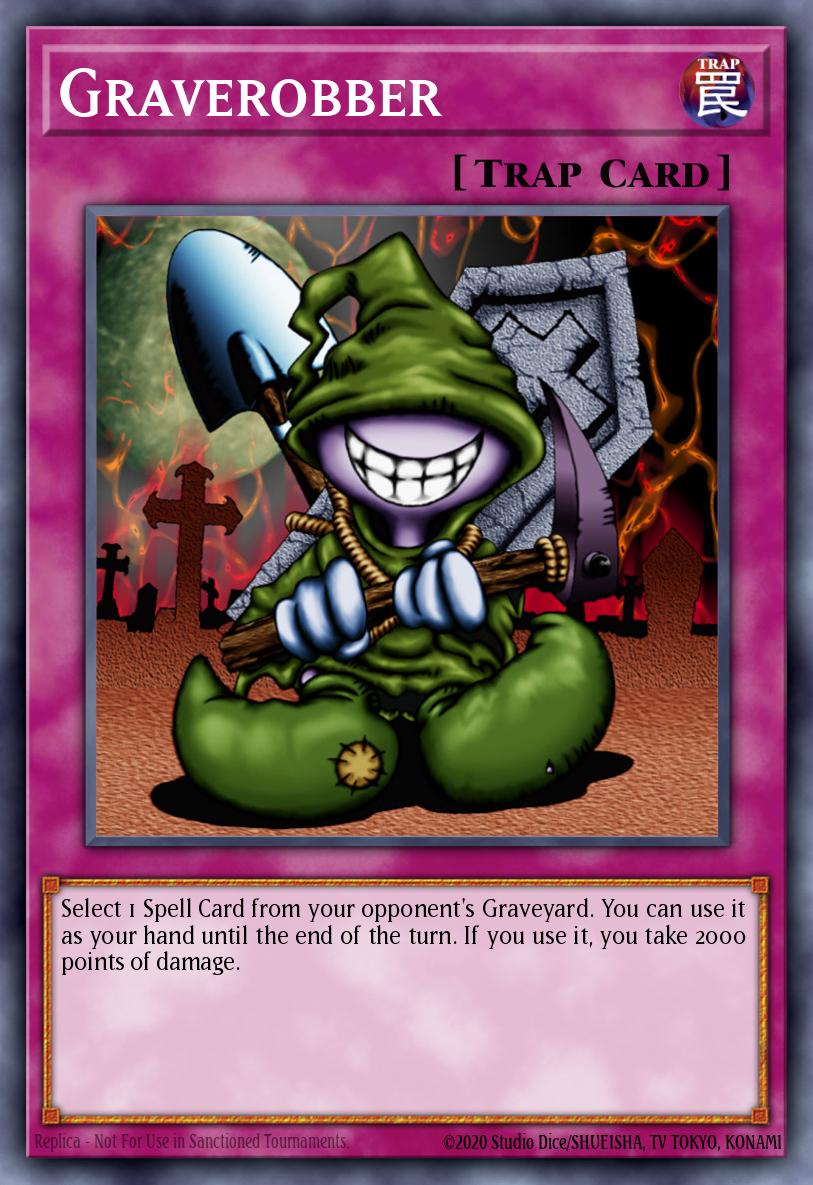
Select 1 Spell Card from your opponent's Graveyard. You can use it as your hand until the end of the turn. If you use it, you take 2000 points of damage.
Graverobber — Power Evaluation
Final Score: 47 ± 6 · Confidence: Medium
- Intrinsic: 47 · Deck: 47 · Meta: provisional
- Primary role: Utility · Secondary: Recovery/Recursion
Why it scores here
Graverobber is a set trap that turns an opponent's Spell in the graveyard into a usable card for the turn, at the cost of 2000 LP. That is a conditional, reactive recursion effect with no searcher, no combo data and no negation, so it converts modestly into value. The card's 34-deck presence across 20 archetypes shows it is a practical generic pick and supports the Deck score, but that frequency does not raise the score on its own. Its 1-copy, free-roll cost keeps the deckbuilding axis high, while its low material and interaction scores keep the overall power in the lower half of the scale.
Axis scores
| Axis | Score | Evidence |
|---|---|---|
| Accessibility | 45 | A set trap that needs an opponent Spell in the graveyard to be live; it appears in 34 decks, mostly as a single copy (verified deck count; the graveyard condition is verified from text). |
| Combo & Conversion | 35 | No combo boards are recorded, so conversion is text-only: a Spell becomes an extra hand card at a 2000 LP cost (inferred). |
| Resource Economy | 50 | Turns an opponent's graveyard Spell into a usable card for free, aside from the life cost, so it is roughly even card-for-card (inferred from text). |
| Effect & Interaction | 30 | Not a negation or removal effect; it is a situational spell-steal with no stop on the opponent's play (inferred from text). |
| Material Utility | 5 | A trap card with no monster body, so it provides no material value (verified from card type). |
| Resilience & Flexibility | 35 | Set-trap access depends on an opponent Spell in the graveyard, and it has no redundancy beyond its single copy (inferred from text and deck copy distribution). |
| Deck-Building Efficiency | 75 | A single copy with no garnets, locks or self-restriction, so it is cheap to run in most lists (observed: 29 of 34 decks run 1 copy). |
Calculation
Weight profile: 0.7 Utility + 0.3 Recovery/Recursion. Intrinsic ≈ 47, Deck ≈ 47, Meta = provisional. Modifiers: none. Final formula: 0.40*Intrinsic + 0.60*Deck
Strengths
- Cheap to run: one copy in 29 of 34 decks and no garnet or lock cost
- Broad spread across 20 archetypes, so it is a portable generic pick
- Gives a usable spell back from the opponent's graveyard at the cost of 2000 LP
Weaknesses
- Needs an opponent Spell in the graveyard to be live
- Reactive and conditional, with no searcher or combo support recorded
- Adds no board presence, negation or material value
Counters / choke points
- Opponent plays that keep Spells out of the graveyard (inferred from text)
- Negation of the set trap before activation (inferred from text)
Best use
Utility / spell-recovery trap, used as a flexible 1-of. Decks: Eyes Restrict, Pendulum Magician, Dark Magician, Red-Eyes, Harpie, D/D/D, Legendary Knight, Greed. Suggested copies: 1.
Evidence & gaps
- Verified: Card text: a Trap that selects a Spell from the opponent's Graveyard, can be used as a hand card until end of turn, and deals 2000 damage when used; 34 decks run it, 29 of them with one copy (avg 1.26 copies); Spread across 20 distinct archetypes and 4 gameplay types
- Observed: Top partners are generic staples (Raigeki, MST, Monster Reborn), which places it in a general spell-heavy shell
- Inferred: Conditional, reactive recursion effect rather than proactive card advantage; Converts modestly into value because the graveyard condition is common but not guaranteed
- Data gaps: no combos supplied; combo conversion is text-only inference no guides supplied no usage statistics (StatisticsCard); archetype inclusion is inferred from the deck sample only no banlist token; assumed 3 copies (unlimited)