






 Spell
 Quick
Foolish Return
View:
3673
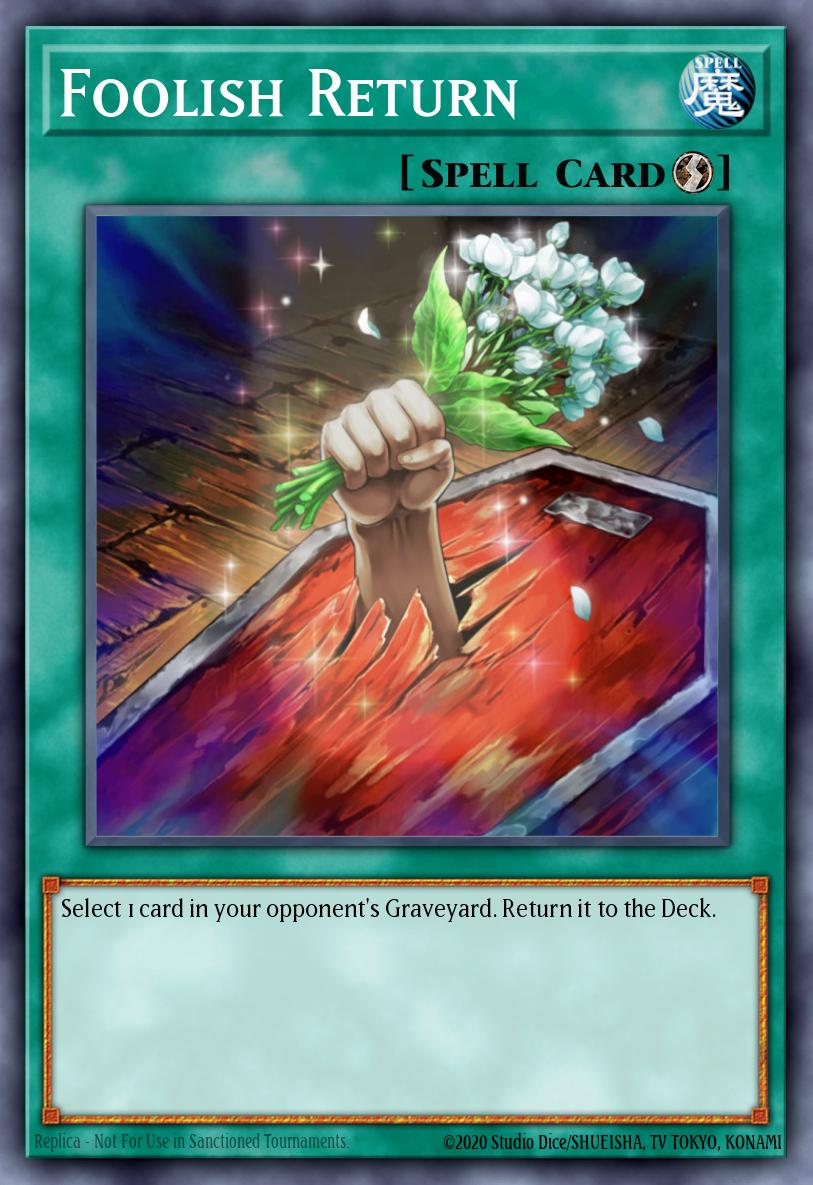
Select 1 card in your opponent's Graveyard. Return it to the Deck.
Foolish Return — Power Evaluation
Final Score: 56 ± 8 · Confidence: Medium
- Intrinsic: 57 · Deck: 56 · Meta: provisional
- Primary role: Removal / Negation · Secondary: Utility
Why it scores here
Foolish Return is a cheap Quick-Play that converts the opponent's graveyard into a small disruption: it returns one card to the Deck, so its value depends on the opponent having a relevant graveyard target. Its score comes from being easy to run and a live card in 150 sampled decks at about 2.56 copies each, across 50 archetypes. It does not build a board or generate card advantage, and the evidence contains no combo data, so combo conversion stays low. The high observed deck count confirms it is a practical staple, not that it is intrinsically powerful, so it does not lift the score on its own.
Axis scores
| Axis | Score | Evidence |
|---|---|---|
| Accessibility | 75 | Run in 150 sampled decks at about 2.56 copies on average, with 94 decks at 3 copies; no combo starter data exists to confirm hand access (observed). |
| Combo & Conversion | 15 | No recorded boards (total_combos 0) and the text only returns a card to the Deck, so it builds nothing by itself (verified text, inferred low conversion). |
| Resource Economy | 40 | A one-for-one that spends the card to remove one opponent graveyard card, with no searches, draws, or refuel; roughly even (verified text, inferred). |
| Effect & Interaction | 55 | Soft, graveyard-only interaction that can answer graveyard-dependent engines and recursion, but it cannot touch the board or the field (verified text, inferred). |
| Material Utility | 5 | Not a material body; it is a spell and provides no levels, attributes, or names (verified text). |
| Resilience & Flexibility | 40 | A single Quick-Play that can be negated and targets a zone the opponent may not use, so it has one use per copy with no recovery (inferred). |
| Deck-Building Efficiency | 80 | A generic non-garnet spell that is cheap to run and splashable; it is playable at up to 3 copies with no lock or brick cost (verified text, observed copy counts). |
Calculation
Weight profile: Removal / Negation primary, no secondary blend. Intrinsic ≈ 57, Deck ≈ 56, Meta = provisional. Modifiers: none. Final formula: 0.40*Intrinsic + 0.60*Deck
Strengths
- Cheap, generic Quick-Play that is easy to include in many archetypes
- Answers graveyard-dependent engines and recursion at the opponent's expense
- Live in 150 sampled decks across 50 archetypes at about 2.56 copies each
Weaknesses
- Conditional: it is dead when the opponent's graveyard is empty or has no useful target
- Does nothing for the board or for card advantage
- No combo evidence to show it converts into a winning line
Counters / choke points
- Negation of the Quick-Play activation
- Graveyard-protection or recursion effects that the opponent can respond to
Best use
Graveyard hate / generic interaction slot. Decks: Decks that want to shut down graveyard-based opponent lines in the sampled archetypes (Snake-Eye, forbidden, Kashtira, Fire King). Suggested copies: 2.
Evidence & gaps
- Verified: Quick-Play Spell: select 1 card in the opponent's Graveyard and return it to the Deck; Formats: TCG, OCG, MasterDuel, DuelLinks
- Observed: Run in 150 sampled decks, 94 at 3 copies, distributed across 50 archetypes; Top partners co-occur in deck lists but this does not show causal strength
- Inferred: Acts as a one-for-one graveyard answer with no card advantage; Its value depends on the opponent having a relevant graveyard target; Interaction is soft and cannot reach the board
- Data gaps: no combos supplied, so combo conversion is text-only inference no guides supplied no banlist token; assumed 3 copies (unlimited) no usage statistics (StatisticsCard); archetype inclusion is inferred from the deck sample only no legal_copies data for any format