






 Trap
 Continuous
DNA Surgery
View:
5635
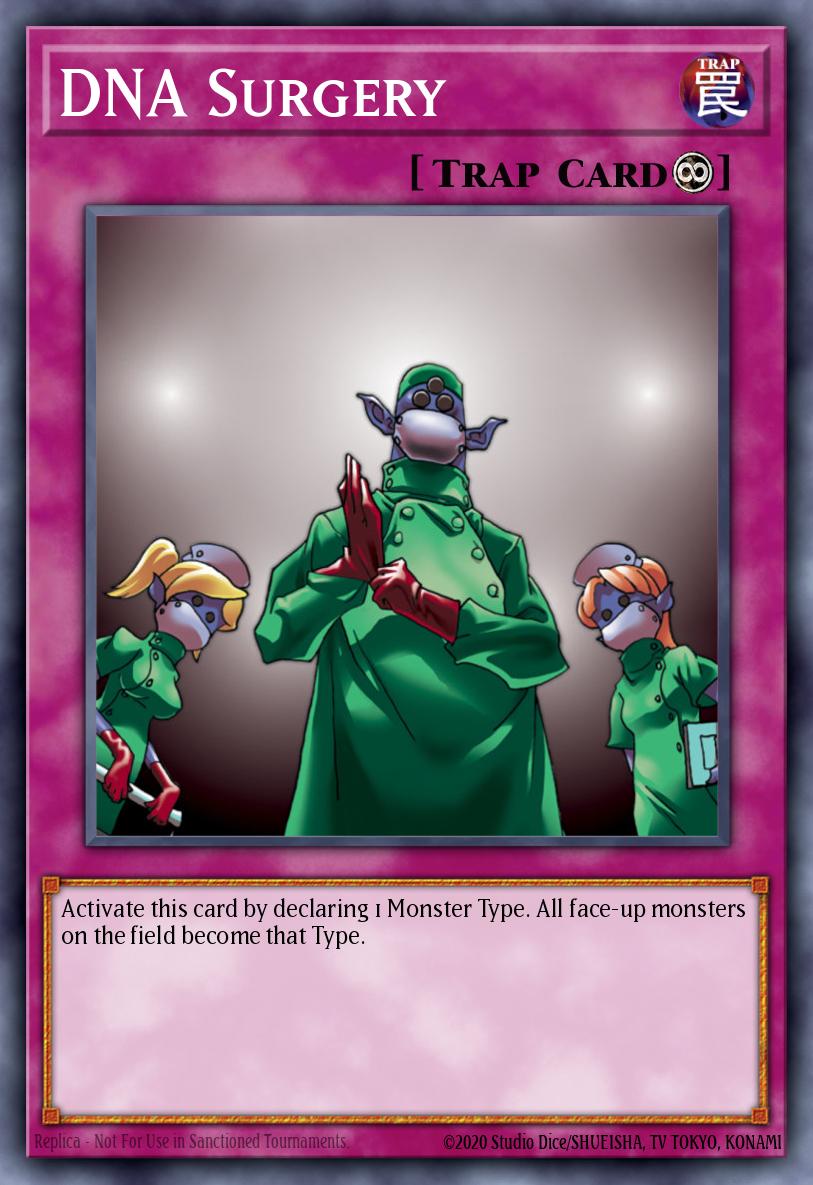
Activate this card by declaring 1 Monster Type. All face-up monsters on the field become that Type.
DNA Surgery — Power Evaluation
Final Score: 52 ± 6 · Confidence: Medium
- Intrinsic: 51.8 · Deck: 52.6 · Meta: provisional
- Primary role: Board breaker · Secondary: Utility
Why it scores here
DNA Surgery is a single Trap that rewrites every face-up monster on the field to one chosen type. Its value is board-wide type control: it can disrupt type-dependent opposing plays and enable a Dragon-type or Warrior-type payoff such as Buster Blader, which the guides say depends on it. It earns little for its card text alone: it has no card advantage, no negation, and no material value, and the 327-deck count reflects a generic slot across 111 archetypes rather than a power level.
Axis scores
| Axis | Score | Evidence |
|---|---|---|
| Accessibility | 55 | Set-and-activate Trap reached through generic staples across 111 archetypes, but no searcher or starter data exists in combos (observed, plus inferred from deck count). |
| Combo & Conversion | 50 | The guide for Buster Blader calls DNA Surgery the core of its combo, but there are zero recorded boards to confirm a conversion rate (observed from guide; inferred from text). |
| Resource Economy | 20 | One card for one effect with no draw, search, or recursion in the text (verified). |
| Effect & Interaction | 45 | Forces a type change on all face-up monsters, which disrupts type-based plays, but has no negation or destruction (verified from text; impact inferred). |
| Material Utility | 10 | Trap card that never reaches the Main Monster Zone as material, so the body has no material value (verified). |
| Resilience & Flexibility | 40 | Trap that can be negated before it resolves and is limited to face-up monsters, with no recurring effect (inferred from text). |
| Deck-Building Efficiency | 70 | One flexible slot with a 1.76 average copy count and no garnets or locks across 111 archetypes (observed from decks). |
Calculation
Weight profile: 0.7 Board breaker + 0.3 Utility. Intrinsic ≈ 51.8, Deck ≈ 52.6, Meta = provisional. Modifiers: none. Final formula: 0.40*Intrinsic + 0.60*Deck
Strengths
- Broad archetype reach: 111 distinct archetypes, so it is portable across homes
- Sets up a type-based payoff (Buster Blader) that the guides name as the core combo
- Cheap, flexible single slot with little deckbuilding cost
Weaknesses
- No card advantage or negation: a one-for-one effect with a narrow board-level impact
- Zero recorded combo boards, so combo conversion rests on guide text and inference
- Trap-based, so it is vulnerable to negation and must be set in advance
Counters / choke points
- Opposing Trap negation or monster-effect negation before the effect resolves (inferred from text)
Best use
Board breaker / type-enabler for Dragon or Warrior payoffs, flexible generic slot. Decks: Buster Blader, Cyber Dragon, Destruction Sword.
Evidence & gaps
- Verified: Trap card that changes all face-up monsters to one declared type; 327 decks, 111 archetypes, average 1.76 copies per deck
- Observed: Guides name DNA Surgery as the core of the Buster Blader combo; Top partners are generic staples, so the card is consistently played
- Inferred: Type control disrupts type-dependent opposing plays; Negatable before resolution, with no recurring effect
- Data gaps: no combos supplied — combo conversion is text-only inference no banlist token — assumed 3 copies (unlimited) no usage statistics (StatisticsCard) — archetype inclusion % inferred from deck sample only