





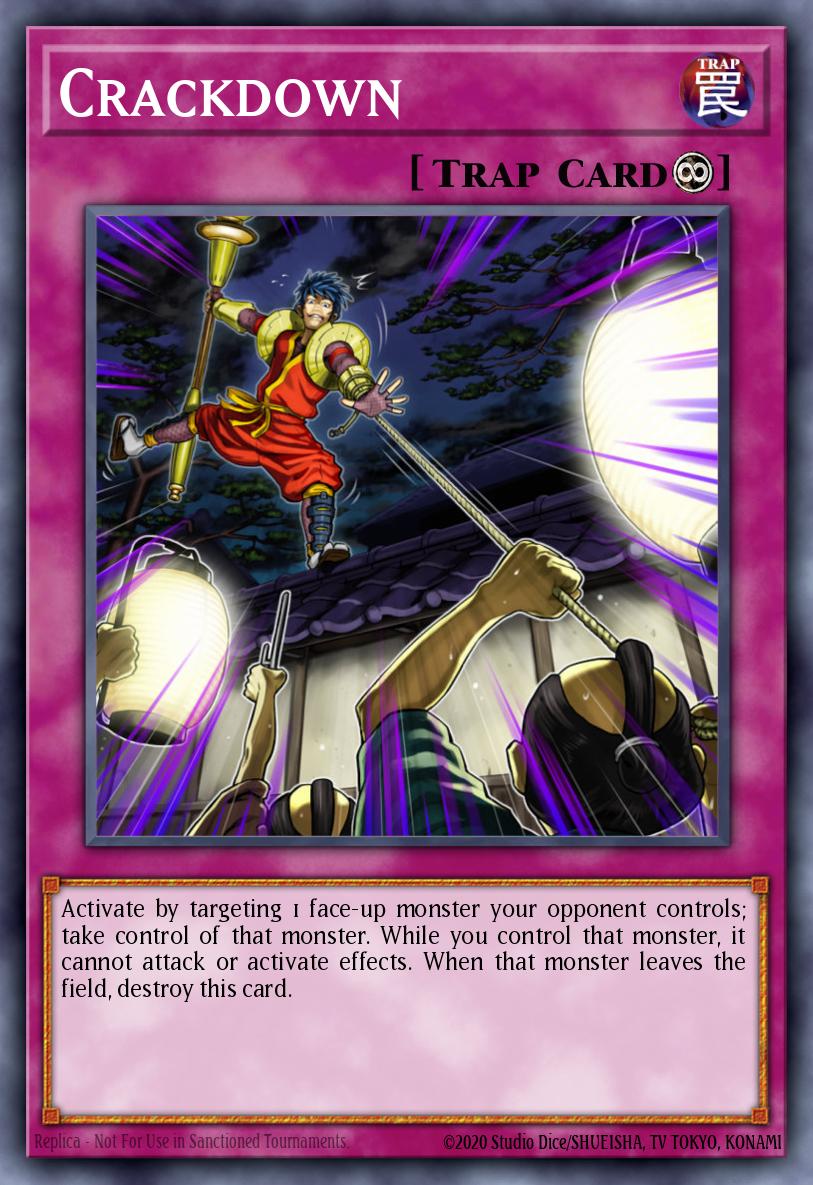

 Trap
 Continuous
Crackdown
View:
9639
Activate by targeting 1 face-up monster your opponent controls; take control of that monster. While you control that monster, it cannot attack or activate effects. When that monster leaves the field, destroy this card.

Crackdown — Power Evaluation
Final Score: 59 ± 6 · Confidence: Medium
- Intrinsic: 57.5 · Deck: 60.5 · Meta: provisional
- Primary role: Removal / Negation · Secondary: Utility
Why it scores here
Crackdown is a set trap that converts one opposing face-up monster into a body you control, but it neutralizes that monster (it cannot attack or activate effects) and is destroyed once the monster leaves the field. Its score comes from that 1-for-1 interaction and from being a generic, low-cost slot that appears in every sampled deck, with 3 copies in most of them. High board power in the combos it appears in (79.2 average) and its 100% appearance rate are not credited to the card itself: none of its combo appearances is labelled starter, searched, material, or payoff, so it earns no combo-conversion credit. Its own body is a trap and cannot be used as material, so material_utility is near zero.
Axis scores
| Axis | Score | Evidence |
|---|---|---|
| Accessibility | 55 | A set trap that is a 3-copy staple in 261 of 400 decks (observed), but with no searcher or recorded starter role, so access depends on drawing it (inferred). |
| Combo & Conversion | 45 | It builds no board by itself; it gains value only by turning an opposing monster into a usable body (inferred), and the 13 combo appearances carry no role labels (observed). |
| Resource Economy | 55 | Roughly a 1-for-1 exchange: it removes an opposing monster and gives you a body back, with no refuel or searches recorded (verified text, inferred balance). |
| Effect & Interaction | 60 | Targets a face-up opposing monster and neutralizes it while you control it, which is strong soft removal but can be stopped by opposing negation (verified text, inferred). |
| Material Utility | 5 | The card is a trap and cannot be material; only the monster it steals can be used, and the stolen monster cannot activate its effects (verified text). |
| Resilience & Flexibility | 45 | It ends when the stolen monster leaves the field, so one monster removal or bounce undoes it; the 3-copy redundancy helps but there is no recovery route (verified text, inferred). |
| Deck-Building Efficiency | 60 | A generic trap that imposes no garnet, lock, or restriction and is run at 1 to 3 copies across 99 archetypes (observed, deck stats). |
Calculation
Weight profile: 0.7 Removal/Negation + 0.3 Utility (secondary blend). Intrinsic ≈ 57.5, Deck ≈ 60.5, Meta = provisional. Modifiers: none. Final formula: 0.40*Intrinsic + 0.60*Deck
Strengths
- Neutralizes an opposing monster and takes control of it, combining removal and a body gain in one card
- Played in 400 of 400 sampled decks across 99 archetypes, so it fits many homes
- Generic trap with no garnet or lock cost and a clean, low-risk slot
Weaknesses
- Set trap: it can be negated by opposing hand traps or spell/trap responses
- Ends as soon as the stolen monster leaves the field, so one removal or bounce undoes it
- Stolen monster cannot attack or activate effects, so it is a blocker and material, not a threat
Counters / choke points
- Opposing negation or hand traps in response to the activation (inferred)
- Removing or bouncing the stolen monster, which destroys Crackdown (verified text)
Best use
Soft removal / control trap in a generic interaction slot. Decks: Utopia, Time Thief, Performage, True Draco. Suggested copies: 3.
Evidence & gaps
- Verified: Card text: targets 1 face-up opposing monster, takes control, neutralizes it, destroys this card when it leaves the field; Present in 400/400 sampled decks; 261 decks run 3 copies, 63 run 2, 76 run 1; legal_copies duellink: 3
- Observed: 99 distinct archetypes; largest shares are 6.5% (Utopia, Time Thief, Performage); Appears in 13/13 recorded combos, but all role flags are zero and the three top examples are identical; Average board power_index 79.2 is a property of the boards, not evidence the card caused it
- Inferred: Set-trap access depends on drawing it; no searcher route is in the evidence; Stolen monster is usable as material or tribute by its new controller; Opposing hand traps or negation can stop activation
- Data gaps: No usage statistics (StatisticsCard); archetype inclusion % inferred from the 400-deck sample only All 13 combo appearances have empty role_in_combo, so starter/material/payoff roles cannot be confirmed The three top combo examples (ids 23, 24, 25) are identical; combo sample is effectively one board from one guide No rulings or metagame sample supplied