






 EARTH
 5
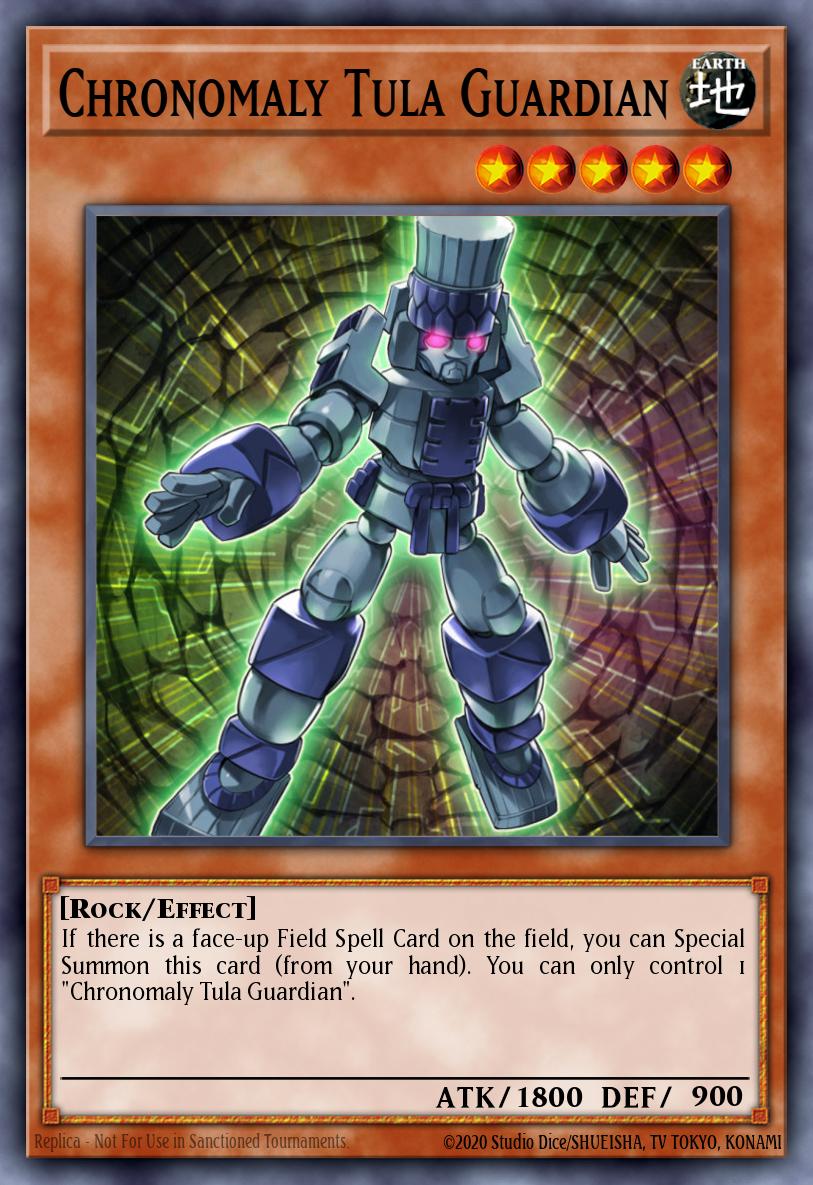
Chronomaly Tula Guardian
Archetype:
Chronomaly
ATK:
1800
DEF:
900
View:
3115
If there is a face-up Field Spell Card on the field, you can Special Summon this card (from your hand). You can only control 1 "Chronomaly Tula Guardian".
Chronomaly Tula Guardian — Power Evaluation
Final Score: 51 ± 6 · Confidence: Medium
- Intrinsic: 49 · Deck: 52 · Meta: provisional
- Primary role: Starter / Combo enabler · Secondary: Material body
Why it scores here
Chronomaly Tula Guardian converts very little on its own: its only text is a conditional hand Special Summon that needs a face-up Field Spell Card, plus a one-per-name limit, and it has no card advantage, interaction or recursion. Its 1800 ATK earns nothing, and its 19-deck presence across 9 archetypes (about 1.6 copies per deck) shows it is a reliable staple that is cheap to run, not that it is strong. The score is held down by the field-spell condition, which the evidence does not show is always met, and by the absence of any recorded combo boards.
Axis scores
| Axis | Score | Evidence |
|---|---|---|
| Accessibility | 45 | Summonable only from hand while a face-up Field Spell is present, but it is in 19 of 19 sampled decks with strong partner co-occurrence, so it is a live card when the condition holds (verified text; observed decks). |
| Combo & Conversion | 30 | No recorded combo boards (0 appearances), and the text gives only a single body with no follow-up, so conversion is text-only inference (inferred). |
| Resource Economy | 35 | No card advantage, search, or GY refuel in the text; it is a one-for-one body (verified text). |
| Effect & Interaction | 10 | No negation, removal, or hand-trap effect in the text (verified text). |
| Material Utility | 55 | Level 5 EARTH Rock body that can serve as a generic material, but no combo data confirms material use (verified text; inferred). |
| Resilience & Flexibility | 40 | The hand summon depends on a field condition and the one-per-name limit caps redundancy, with no recursion or multi-zone effect (verified text; inferred). |
| Deck-Building Efficiency | 70 | Runs 1 to 3 copies with no garnet or lock restriction, and the 1-per-name limit is easy to respect (observed decks; verified text). |
Calculation
Weight profile: 0.7 Starter / Combo enabler + 0.3 Material body / Normal. Intrinsic ≈ 49, Deck ≈ 52, Meta = provisional. Modifiers: none. Final formula: 0.40*Intrinsic + 0.60*Deck
Strengths
- Appears in 19 of 19 sampled decks across 9 archetypes, so it fits into many homes
- Cheap to run at 1 to 3 copies with no garnet or lock restriction
- Generic Level 5 EARTH Rock body that can be used as material
Weaknesses
- Hand summon needs a face-up Field Spell Card, which is a real condition
- No card advantage, interaction, or recursion in its text
- One-per-name limit and no combo evidence keep its conversion low
Best use
Conditional hand-summoned body that fills a Chronomaly or Orcust line when a Field Spell is out. Decks: Chronomaly, Orcust, Naturia, Familiar-Possessed, Adamancipator. Suggested copies: 2.
Evidence & gaps
- Verified: Special Summon from hand requires a face-up Field Spell Card on the field (card text); Only 1 copy may be controlled by name (card text); Level 5, EARTH, Rock, 1800 ATK / 900 DEF (card stats); Present in 19 of 19 sampled decks, 1.58 copies on average (deck data)
- Observed: Top partner co-occurrence with Chronomaly Vimana at 89.5% of decks (deck data); Spread across 9 archetypes, led by Chronomaly (5 decks) and Orcust (4 decks) (deck data); Gameplay type 7 holds 68.4% of decks (deck data)
- Inferred: Its Field Spell condition limits how often it can be summoned, so accessibility is partial; Its Level 5 EARTH body makes it a generic material, though no combo data confirms this
- Data gaps: no combos supplied, so combo conversion is text-only inference no banlist token, so 3 copies (unlimited) is assumed no usage statistics (StatisticsCard), so archetype inclusion is inferred from the deck sample only no starter-count data, so DeckResilience is estimated from archetype spread alone the Field Spell condition is not checked against which Field Spells the sampled decks run