






 Spell
 Quick
Bownty
View:
2756
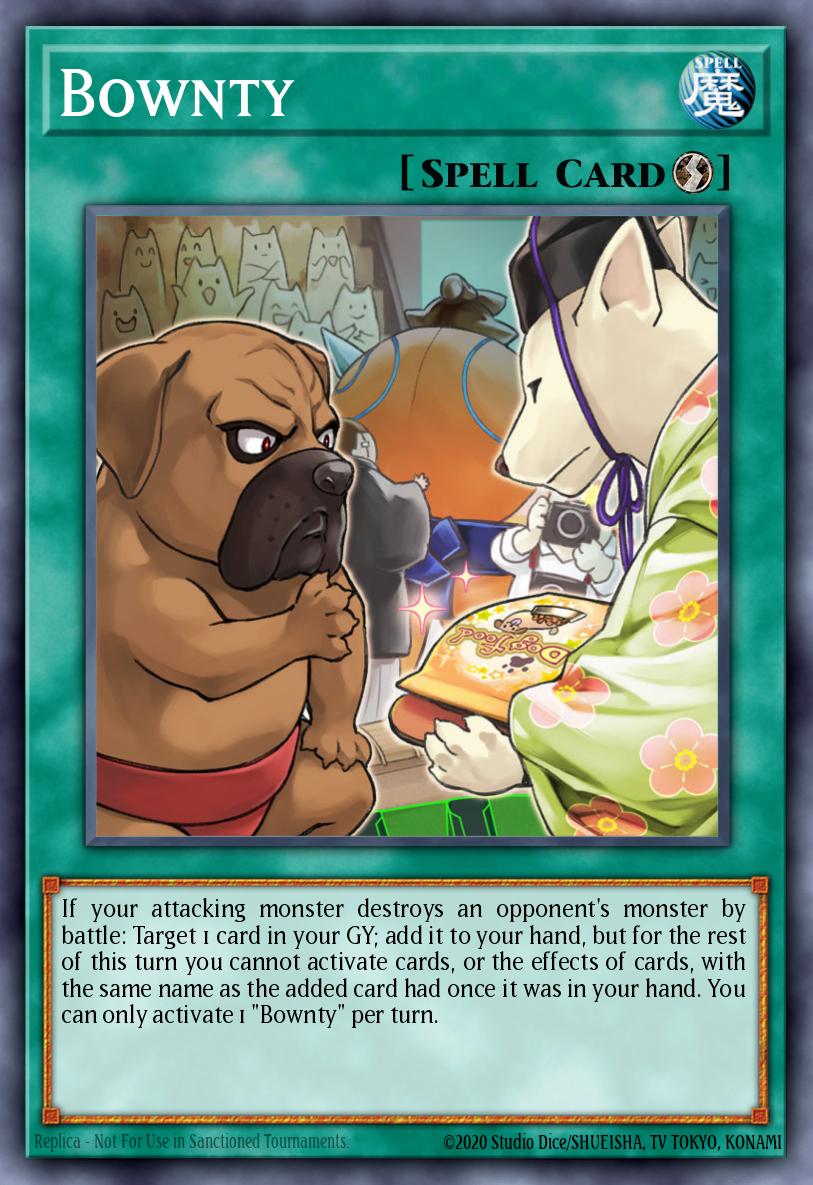
If your attacking monster destroys an opponent's monster by battle: Target 1 card in your GY; add it to your hand, but for the rest of this turn you cannot activate cards, or the effects of cards, with the same name as the added card had once it was in your hand. You can only activate 1 "Bownty" per turn.
Bownty — Power Evaluation
Final Score: 44 ± 8 · Confidence: Medium
- Intrinsic: 44 · Deck: 45 · Meta: provisional
- Primary role: Recovery/Recursion · Secondary: Searcher/Tutor
Why it scores here
Bownty is a Quick-Play spell that only activates after one of your attacking monsters destroys an opponent's monster in battle, and it then returns one card from your GY to hand. That is a one-for-one recovery with no direct interaction, so it converts GY resources into a card rather than building a board. The score reflects a conditional, low-impact recovery effect, not its presence in 8 decks; frequency only supports that it is practical. The once-per-turn limit and the same-name activation lock are cheap to run, which helps deckbuilding, but the card has no combo evidence to show it converts into a larger line.
Axis scores
| Axis | Score | Evidence |
|---|---|---|
| Accessibility | 40 | Usable only after a battle destruction, and the deck sample shows 8 decks with 1 copy each, mostly Gem-Knights (inferred and observed). |
| Combo & Conversion | 35 | Recovers one GY card, but no recorded combo boards exist to show it builds further (inferred, since combo data is empty). |
| Resource Economy | 50 | Spends itself and returns one GY card, so the net card count is roughly even (verified from card text). |
| Effect & Interaction | 10 | No negation, removal, or hand-trap reach; the effect is a recovery only (verified from card text). |
| Material Utility | 5 | A Spell card with no material or level value (verified from card type). |
| Resilience & Flexibility | 35 | Requires a battle destruction to trigger and is easy to shut down by stopping that battle (inferred from text). |
| Deck-Building Efficiency | 80 | One copy per deck, no garnet or lock beyond the once-per-turn and same-name clauses, so it is cheap to run (verified from card text and deck evidence). |
Calculation
Weight profile: Recovery/Recursion primary weights, no secondary blend applied because the secondary role is Searcher/Tutor, weight blend 0.7 Recovery + 0.3 Searcher not applied; primary weights used directly. Intrinsic ≈ 44, Deck ≈ 45, Meta = provisional. Modifiers: none. Final formula: 0.40*Intrinsic + 0.60*Deck
Strengths
- Converts a spent Spell into a GY card back in hand, so it is card-neutral and does not cost a board presence
- Very cheap to run: one copy per deck with no garnet-style restriction
- Used in 8 recent decks across 5 archetypes, so the role is practical and not a forgotten pick
Weaknesses
- Only triggers after your attacking monster destroys an opponent's monster by battle, so it is dead if no battle destruction happens
- Does not interact with the opponent or build a board by itself
- The same-name activation lock limits follow-up plays on the added card in that turn
Counters / choke points
- Stopping the battle destruction (monster-protection or battle-prevention effects) prevents the trigger entirely
- Opponent removal or negation of the attacking monster before damage calculation shuts the line
Best use
Recovery/Recursion: returns one GY card after a battle destruction, mostly in Gem-Knight shells. Decks: Gem-Knights, Vernusylph. Suggested copies: 1.
Evidence & gaps
- Verified: Quick-Play Spell with a battle-destruction trigger and a return-one-GY-card-to-hand effect, plus a once-per-turn limit and same-name activation lock (card text); One copy in each of 8 decks, 4 of them Gem-Knights (deck data)
- Observed: Gem-Knight and Vernusylph partners appear in 50% of decks running it (deck data top partners)
- Inferred: Usable as a one-for-one recovery in battle-heavy shells, but the trigger makes it unreliable in non-battle lines; Conditional recovery rather than a board-building card, so combo conversion is low
- Data gaps: no combos supplied, so combo conversion is text-only inference no guides supplied no usage statistics (StatisticsCard) for archetype inclusion, so inclusion is from the 8-deck sample only no banlist token, assumed 3 copies (unlimited)